Snow blower specs, and the complaints that come with them
Clearing width, intake height, engine, drive and chute for every machine, plus what owners report going wrong.
Severity key — what each class is rated to clear
Light snow on paved walks
Up to ~8" on pavement
Deep, wet, gravel, plow berm
Lake-effect and EOD ice
The catalogue
Every machine we track
Filter by brand, type, clearing width, or price. Tick the checkbox on up to three machines to put their spec sheets next to each other.
67 machines
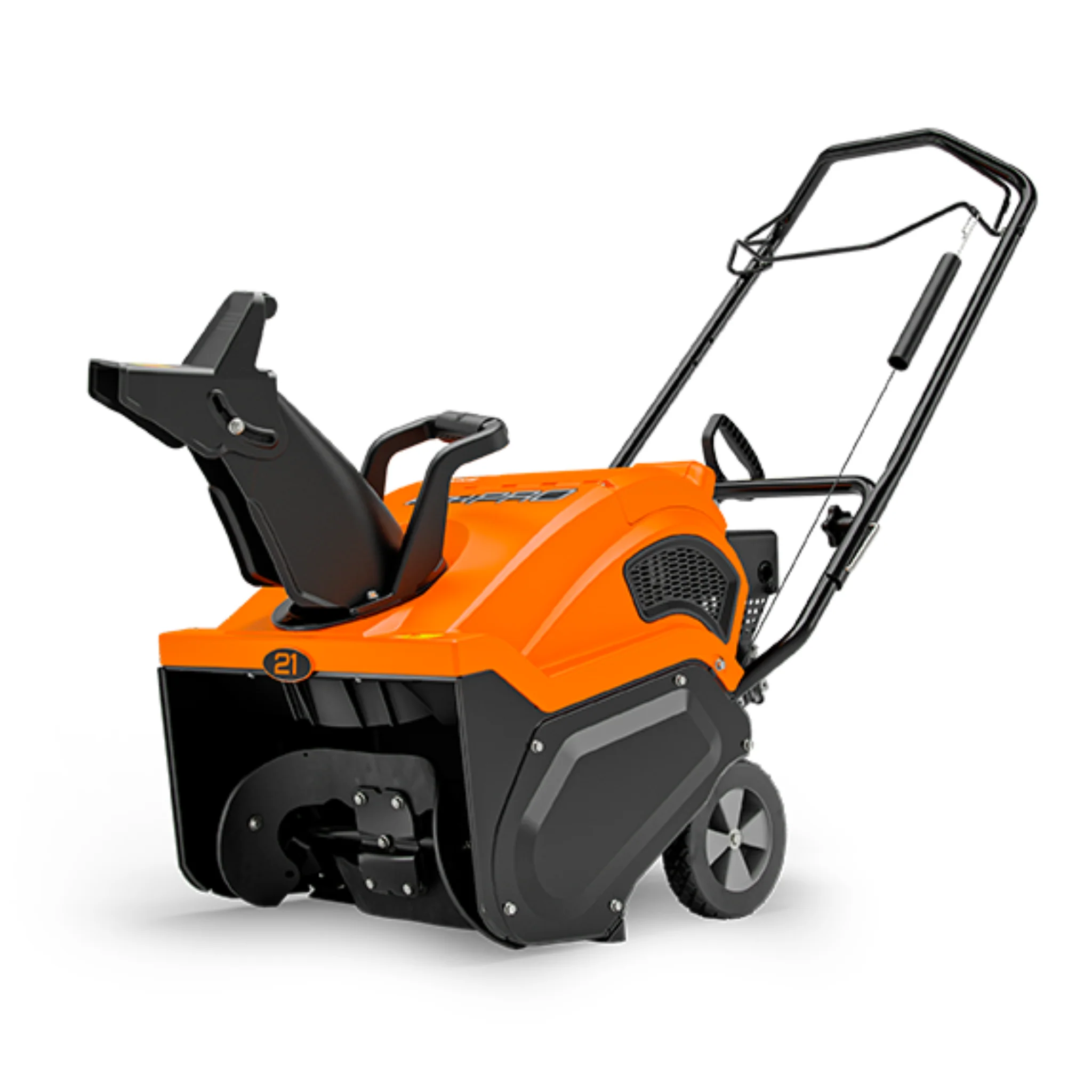
21" wide · 35 ft throw · 95 lb
The Path-Pro is what happens when a two-stage company builds a single-stage: a 208cc AX engine that's comically large for a 21-inch paddle machine, steel housing instead of the usual plastic tub, ball-bearing supported auger, and an adjustable scraper bar you can actually replace when it wears. Owners on Snowblower Forum call it 'an outstanding performer' — it eats 6-9 inches of snow and genuinely hits its 35-foot throw rating, where a Toro Power Clear 721 runs about 6 lb lighter with slicker controls but less grunt in the heavy stuff. Because the paddles pull it along, you walk it like a self-propelled mower and it scrapes clean to the pavement — this is the pick for decks, sidewalks, and one-car-wide city driveways. Honest downsides: at 95 lb it's the heavyweight of the single-stage class, chute rotation is a manual handle unless you pay for the remote kit, there's no headlight, and like all paddle machines it will bounce off anything deeper than a foot or the icy EOD wall. If your snow is regular but rarely epic, it's the most durable single-stage sold.
Best for Sidewalks, decks, and one-car paved driveways with regular sub-foot snowfalls — the durable single-stage for people who hate disposable machines.

24" wide · 80V, 2×4.0Ah batteries (5kW brushless) · 176 lb
This is one of the few battery two-stages that owners genuinely describe as a gas replacement — the 5kW brushless motor is pitched as 252cc-equivalent, and Best Buy reviewers back it up with reports of no bogging and no clogged chute in heavy snow. The self-propelled drive with reverse, 24x18-inch mouth, and up to 50-foot throw put it squarely against the EGO SNT2405 and Toro 60V Power Max, usually for less when Best Buy runs its frequent $1,400 sales (list hovers near $1,800-$2,000). Real-world limits: the two included 4.0Ah packs are the small ones — expect 30-45 minutes in deep, wet snow, so the tri-port's third-battery slot isn't a gimmick, it's the upgrade path. At 176 lbs it's a handful in the garage with the power off, cold soak below 10°F cuts runtime, and there are no heated grips at a price where gas rivals include them. For an 8-car driveway in a 40-inch-a-year climate, it's the quiet, no-maintenance pick.
Best for Homeowners with large driveways in real snow country who want gas-class two-stage power without the engine maintenance.
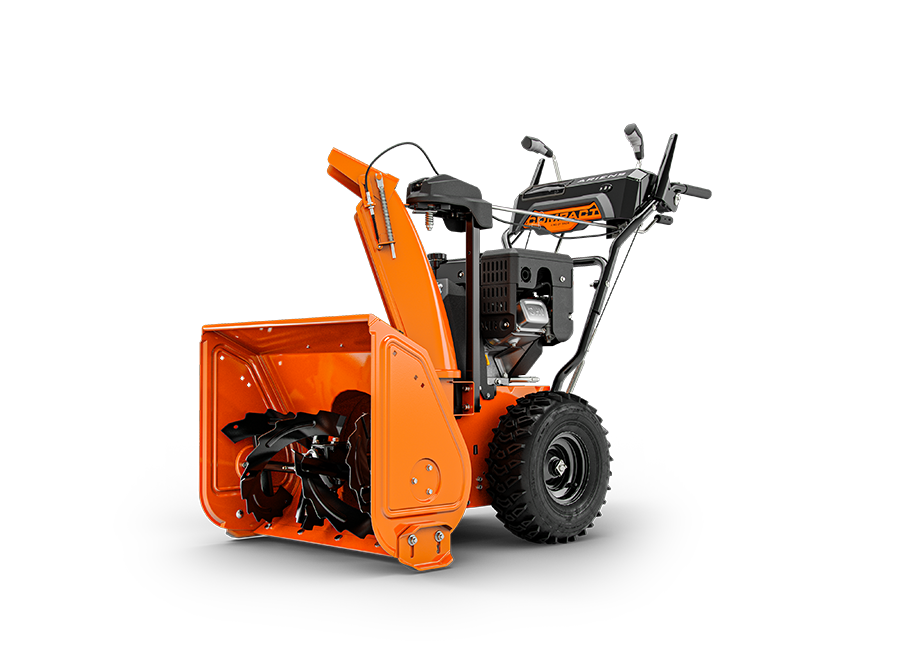
Ariens Compact 24
~$1,29924" wide · 40 ft throw · 187 lb
The Compact 24 is the cheapest way into a real Ariens two-stage, and the appeal is that the money went into the metal: all-steel bucket and dash, cast-iron gear case with a 5-year warranty, and the same Auto-Turn steering as the Deluxe line. Owners consistently call the build quality absurd for a $1,300 machine, and the 120V plug-in electric start means it fires on the first press in January. The honest knock is the 224cc engine — forum owners report it bogs in deep, wet snow at anything above the lowest speeds, and it's noticeably happier in fluffy powder than in the slush a plow leaves at the end of the driveway. At 187 lb with a 20-inch intake it's genuinely maneuverable, which is why it sells to people with one- or two-car paved driveways in moderate-snow states. Against a Toro Power Max 824 OE, the Toro clears wet snow with less drama, but the Ariens is the sturdier machine you'll still be running in 20 years. Buy it for the frame, drive it a gear slower in the heavy stuff.
Best for One- to two-car paved driveways in moderate snow regions where build quality matters more than raw wet-snow power.

Ariens Deluxe 24
~$1,49924" wide · 50 ft throw · 246 lb
The Deluxe 24 is the machine owners tell people to buy when they ask 'what's the safe choice?' — and the current 921069 keeps that formula: 252cc AX engine, a big 14-inch auger AND 14-inch impeller (most 24s run 12-inch impellers), dual-belt drive, and a 21-inch-tall steel bucket that swallows EOD piles. Owners love that it throws heavy snow a real 40-50 feet and that the cast-iron gear case is basically lifetime hardware. The eternal comparison is Toro's Power Max 826 OXE: the Toro is ~50 lb lighter with slicker chute controls and an anti-clog system, while the Ariens counters with a steel chute, sturdier frame, and better distance. Knocks are real but minor — Auto-Turn can wander on rutted gravel until skids are dialed in, heated grips are no longer standard on the Deluxe line, and several Home Depot reviewers report factory bolts backing out early ('torque everything before first use'). It's the default pick for two-car driveways in serious snow country, and resale is the best in the class.
Best for Two-car paved driveways in snow-belt states — the do-everything 24-inch that handles wet Nor'easter loads without drama.

Ariens Deluxe 30
~$1,89930" wide · 50 ft throw · 276 lb · heated grips
The Deluxe 30 is for people who clear a lot of area and want fewer passes: a 30-inch bucket knocks a three-car driveway down 20% faster than a 24, and the 921071 keeps the goodies — 14-inch auger and impeller, dual-belt drive, cast-iron gear case, LED light, and (unlike the smaller Deluxes) standard heated handgrips. Owners praise how planted the 276 lb frame feels punching into end-of-driveway berms, and Auto-Turn keeps it from being a wrestling match. The honest physics problem: it runs the same 301cc AX as the Deluxe 28 SHO but spreads that torque across two extra inches of bite, so in a foot of wet-slop you'll be dropping to the granny gears while a 28 SHO keeps trotting — the forum crowd's rule is 'buy width for light-to-average snow, buy the SHO for slop.' It's a favorite of Upper Midwest owners with wide concrete driveways and long frontage sidewalks. Against Toro's Power Max HD 30-inch, the Toro clogs less in slush; the Ariens throws farther and its steel chute will outlive the Toro's plastic one.
Best for Wide three-car driveways and long frontage in average snow regions — maximum coverage per pass with dealer-grade build.

Ariens Deluxe 28
~$1,64928" wide · 50 ft throw · 233 lb
The Deluxe 28 is Ariens' best-selling size and the machine you see chained down on half the trailers in Wisconsin every November: a 28-inch steel bucket, 14-inch auger and impeller, cast-iron gear case, and the 252cc AX engine, at a price that undercuts the SHO version by about $150. For most storms it's all the machine anyone needs — owners report 8-10 inch clearings at near-top gear and honest 40-50 foot throws in dry snow. The catch the forums flag: it shares its 252cc engine with the Deluxe 24, so those four extra inches of bite come out of your speed in wet, deep snow — if you regularly get slop, the 28 SHO's 301cc is the smarter $150. Auto-Turn makes it pivot like a much smaller machine, and the new generation dropped weight to 233 lb, which owners with sloped driveways appreciate. Heated grips slid to the options list this generation, an annoying delete at $1,649. Against Toro's Power Max 828, the Toro's anti-clog and Quick Stick chute are slicker; the Ariens is the more overbuilt frame with better resale. The default big-driveway pick for average snow.
Best for Two-to-three-car driveways in average snow regions — maximum width per dollar in the Ariens line.

18" wide · 25 ft throw · 58 lb
Toro's entry-level gas single-stage is the machine owners recommend when someone's back gives out but their budget hasn't recovered: about $609, 58 pounds, and a 99cc Toro Premium OHV four-stroke that starts with a push-button (plug in an extension cord) or a single pull. The party trick is the Power Curve rotor - the curved rubber paddles scrape clean to pavement and actually pull the machine forward, so there's no drive system to maintain and no pushing to speak of. Owners love that it stores upright in a closet-sized footprint and tosses powder a legit 25 feet. The honest knocks: the chute handle lives on the chute, so you're reaching down to redirect mid-pass; 12 inches of intake height disappears fast in a real dump; and wet end-of-driveway slop will stall your progress if you take full bites. Against Ariens' Path-Pro 208E it gives up 100cc but costs less, weighs less, and carries a 4.5-star average across 1,600+ Ace Hardware reviews. For a two-car paved driveway in a normal-snow city, this is the sane default.
Best for The city homeowner with a short paved driveway and sidewalks who wants gas reliability without gas bulk.

21" wide · 35 ft throw · 84 lb
The 721 E has quietly become the default 'just buy the Toro' answer for paved driveways - 1,800+ reviews averaging 4.5 stars and a decade of the 212cc four-stroke proving itself. It throws snow up to 35 feet, starts with a push-button (via 120V cord) or first pull, and the Power Propel paddle drive pulls itself forward hard enough that you're steering more than pushing. The Quick Chute lever spins the 210-degree chute without stopping, and unlike the two-strokes of old there's no gas-oil mixing. Owners' complaints are specific: the chute lever is short and awkward for some hands, single-stage paddles ride up on hardpack and can't touch gravel, and a foot-deep wet storm means slow, half-width bites. Early units had scattered reports of the exhaust cooking a control cable, largely sorted in later production. Honda's exit from US snow blowers removed its only real single-stage rival, so at $799 the 721 E mostly competes with its big brother 821 QZE - buy the 721 if your snow is usually under 9 inches and your driveway holds four cars or fewer.
Best for The suburban homeowner with a 2-4 car paved driveway who wants the proven, no-drama gas single-stage everyone recommends.

21" wide · 40 ft throw · 95 lb
This is the biggest engine anyone puts in a single-stage - a 252cc Toro Premium OHV in a 95-pound, 21-inch machine - and it exists for people who want two-stage punch without two-stage bulk. Forum consensus on the 821-vs-721 question is refreshingly honest: it won't clear anything the 721 can't, but it's noticeably quicker through deep, dense snow and hurls slush up to 40 feet instead of dribbling it. The Power Propel paddles yank it forward aggressively (feather your grip on ice), electric start is push-button with a cord, and the Zip Deflector flips throw height with a palm tap. Knocks from the 631 owner reviews averaging 4.5 stars: it's front-heavy for a single-stage, the chute handle still requires a reach, and at $999 you're within sight of a real two-stage Power Max 824 on sale. Still no gravel, still 12.5 inches of intake. Buy it for wide city driveways with heavy plow drool at the curb; skip it if your snow is fluffy and occasional - the 721 does that job for $200 less.
Best for The homeowner in heavy-wet-snow country who wants maximum single-stage power for plow piles but has no room for a two-stage.

Toro Power Max 824 OE
~$1,39924" wide · 45 ft throw · 184 lb
The Power Max 824 OE is the price of entry to Toro's two-stage world and probably the best value in the lineup: $1,399 gets you the same 252cc engine as the flagship 826 trims, a 24-inch bucket with a full 20 inches of intake, and a legit 45-foot throw. Toro's Anti-Clogging System is the sleeper feature - it meters what the auger feeds the impeller, so heavy wet snow keeps flying instead of packing the chute - and there are no shear pins to snap; hardened gears plus an engine that deliberately stalls on impact stand in for them, which unnerves first-timers and delights everyone else. The Quick Stick joystick moves chute and deflector in one motion and is genuinely nicer than Ariens' crank. What you give up versus the 826 OHAE: no triggerless steering, no hand warmers, no headlight - and 184 pounds takes some muscle in turns. Against the Ariens Compact 24 (224cc), the Toro throws farther and clogs less; Ariens counters with auto-turn steering. Over 1,100 Ace reviews average 4.5 stars. The pragmatist's two-stage.
Best for The value-focused buyer stepping up to their first two-stage for a 4-10 car driveway who can skip heated grips and auto-steer.

Toro Power Max HD 828 OAE
~$1,74928" wide · 45 ft throw · 240 lb
This is Toro's heavy-duty tier - HD frame, commercial-grade auger gearbox, 16-inch deep-lug tires, and a 21-inch-tall all-steel bucket that eats the end-of-driveway berms a standard Power Max nibbles at. With the 265cc 928 OAE discontinued, this is now the 28-inch machine in Toro's HD line, keeping the ubiquitous 252cc Premium OHV; spec-sheet shoppers fret about the displacement, but owner reviews (4.5 stars, 400+) say it powers through plow walls without drama because the Anti-Clogging System keeps the impeller loaded steadily instead of gulping. Triggerless steering makes 240 pounds pivot like 150, the Quick Stick flicks the steel chute through 200 degrees, and there are no shear pins - hit a frozen newspaper and the engine stalls rather than snapping hardware. The comparison everyone runs is the Ariens Deluxe 28: similar money, Ariens has auto-turn and the dealer cult, the Toro clogs less and steers easier. Knocks: no hand warmers at this price (the kit is $126), and it's a garage hog. For 100-foot drives and plow-strike duty, the honest pick.
Best for The long-driveway owner who fights a municipal plow every storm and wants HD durability without stepping up to 300cc money.

Toro Power Max HD 1030 OHAE
~$2,14930" wide · 45 ft throw · 290 lb · heated grips
The 1030 OHAE is the biggest snow blower most homeowners should ever need: a 302cc Toro Premium four-stroke swinging a 30-inch all-steel bucket with 21 inches of intake, throwing snow up to 45 feet. It's the machine for 150-foot rural driveways, drifted-in corners, and the concrete berm the county plow leaves at 5 a.m. - owners report it barely notices two feet of accumulation taken in sensible bites. Triggerless steering is what makes 290 pounds livable, unlocking the inside wheel as you lean into turns, and the hand warmers, LED light, and Quick Stick chute control mean you never take a glove off. Toro's no-shear-pin gearbox and Anti-Clogging System carry over from the rest of the line, so maintenance amounts to oil changes and a friction disc someday. Knocks from the 4.5-star, 220-plus review base: it's enormous to store, heavy to load in a truck, overkill for under 40 feet of pavement, and its price bumps against the Ariens Platinum 30 SHO, which brings 420cc for a few hundred more. If snow is a lifestyle problem where you live, this ends the conversation.
Best for The rural or lake-effect homeowner with a huge driveway who wants one machine that never meets a storm it can't out-muscle.

21" wide · 60V 7.5Ah (405Wh) · 55 lb
Toro's battery single-stage is the rare cordless machine that gas people concede is legitimate - one six-season owner on Snowblower Forum called it flat-out better than his EGO and only a notch behind a gas 721 E. The 60V brushless motor ramps power with load, the Power Curve paddles scrape to pavement and pull the 55-pound machine forward, and it throws cold powder up to 40 feet. It's also quiet enough for 5 a.m. and starts with a bail squeeze - no cord, no choke, no carburetor to gum up over summer. The honest limits: the included 7.5Ah pack clears roughly an 8-to-12-car driveway of moderate snow, but wet heavy stuff can halve that, spare L405 batteries are painfully expensive, and the stubby chute's deflector is awkward to adjust mid-pass. At $749 it undercuts EGO's comparable kit while sharing packs with Toro's 60V mowers and trimmers, which is the whole ecosystem play. Over 1,000 Ace Hardware reviews average 4.5 stars. For paved driveways and storms under 10 inches, this is the future arriving politely.
Best for The suburbanite with a paved 2-4 car driveway who already owns (or wants) Toro 60V yard tools and is done with gas cans.
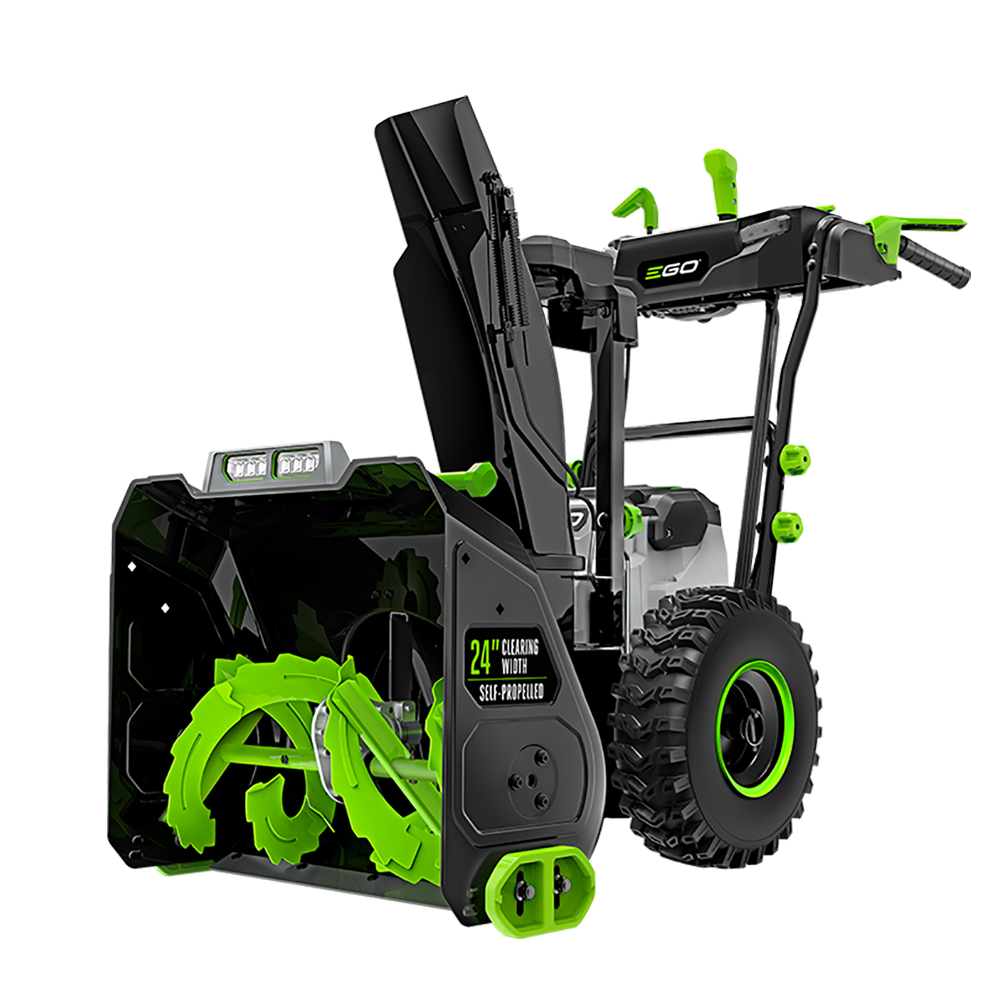
24" wide · 56V 7.5Ah × 2 (Peak Power) · 143 lb
The SNT2405 was the first battery two-stage that felt like a real gas replacement, and with 4.5 stars across nearly 6,000 Ace reviews it has aged well. Independent motors run the drive and steel auger, reverse is genuinely useful on a 143-lb machine, and the 50-foot throw claim is only mildly optimistic in dry snow. The blunt part from owners: the 18-car-driveway runtime claim is powder math. In heavy wet snow one reviewer barely finished a one-car, 50-foot driveway before both 7.5Ah packs quit — figure 30-45 minutes of real work, and budget a second battery set (about $430 each) for long driveways. Packs stored warm indoors shrug off cold mornings; frozen ones sag until they warm. Notably missing at $1,649: heated grips, which Ryobi's Whisper 24 includes for similar money. Versus Toro's 60V Power Max e24 it's the more proven machine with a deeper battery ecosystem; versus an Ariens Compact 24 gas unit you pay roughly $500 extra for push-button silence and zero engine upkeep. For 8-12 inch storms on a 2-3 car driveway, it's the sweet spot of EGO's line.
Best for Suburban homeowners with 2-3 car driveways and 8-12 inch storms who want gas-class two-stage power without the engine upkeep.
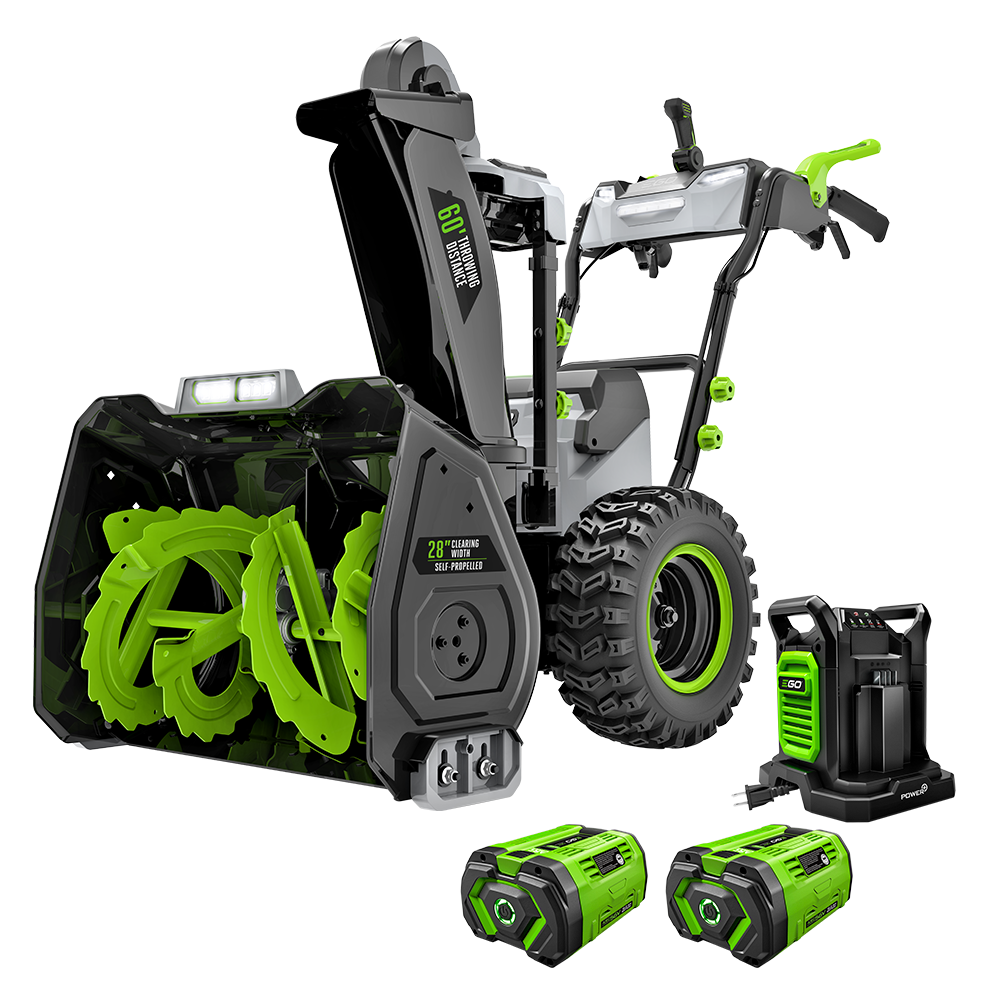
28" wide · 56V 12.0Ah × 2 (Peak Power) · 182 lb · heated grips
The SNT2807 is EGO's flagship, and it's the rare battery two-stage that owners on Snowblower Forum discuss like a gas machine — 28 inches wide, 21-inch intake, trigger steering, heated grips, and a 60-foot throw claim that lands closer to 35-45 feet in real snow. The two included 12Ah packs are the biggest EGO makes, and that's the point: smaller packs technically run it but sag on end-of-driveway piles, so the 32-car-driveway claim only holds in light snow with these monsters aboard. Expect roughly 45-60 minutes of honest work in a heavy storm. Battery math is the knock — a replacement BA6720T runs about $659, $1,099 a pair — so store them indoors; cold-soaked packs lose 10-20% until they warm up. At $2,419 you're paying roughly $1,000 over an Ariens Deluxe 28 gas machine for silence, push-button starts, and zero carburetor drama. Against Toro's 60V Power Max e26, the EGO throws farther and its 2-in-1 electronic chute is slicker to live with. If your area gets repeated foot-plus dumps and you want battery power, this is the only EGO that truly belongs there.
Best for Deep-snow households with long or multi-car driveways who want the most capable battery snow blower money can buy.
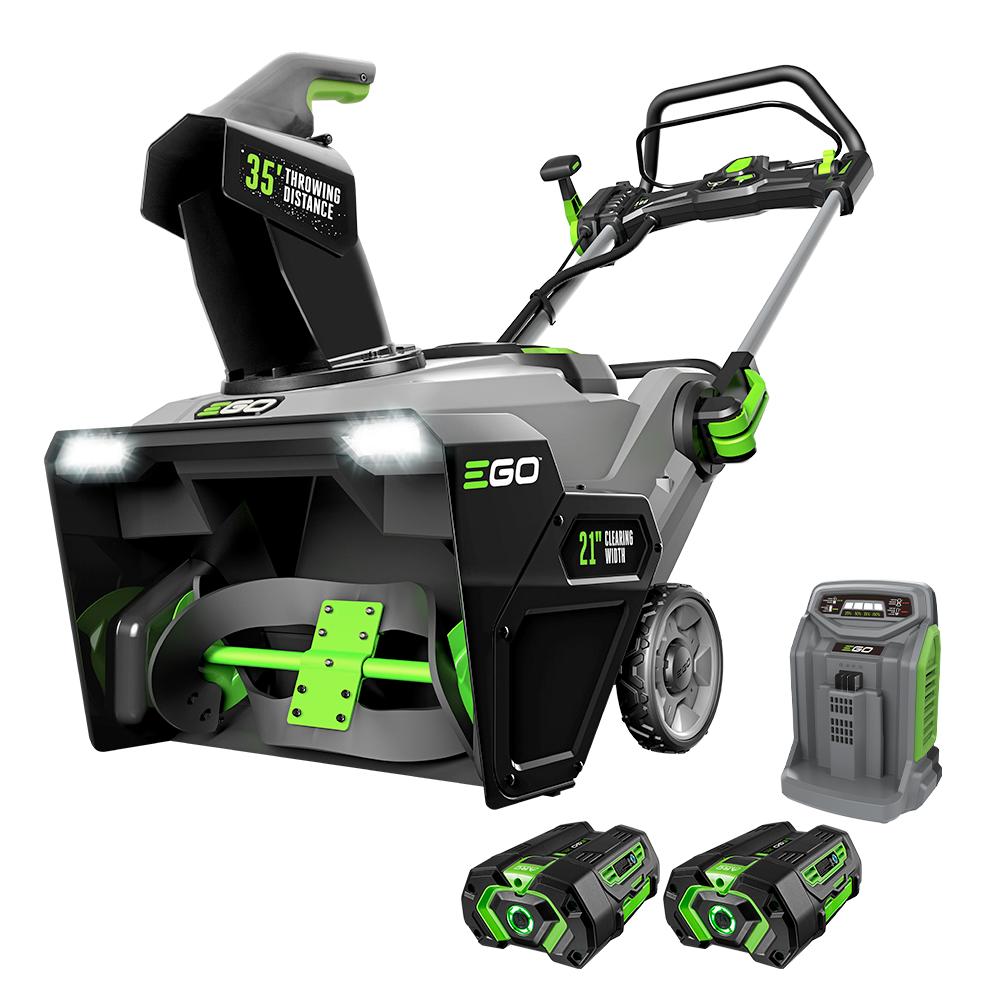
21" wide · 56V 5.0Ah × 2 (Peak Power) · 61 lb
The SNT2102 is the cheapest way onto EGO's 56V snow platform and still one of the best-reviewed battery single-stages anywhere — 4.4 stars across more than 4,000 Lowe's reviews. With two 5.0Ah packs feeding Peak Power it genuinely handles the 6-8 inch storms most of the country actually gets, starts with a button in any temperature, and is light enough to lift onto a deck. Owners are blunt about the limits: heavy wet snow chews through the packs in 20-30 minutes, and the rubber-tipped auger rides up on compacted plow crust instead of biting in — that's exactly what the steel-auger SNT2114 fixes for $350 more. The 35-foot throw is a dry-powder number; expect half that in slush. Batteries stored indoors behave fine in the cold, but packs left below 20°F sag noticeably until they warm up. At $649 with batteries it undercuts Toro's 60V Power Clear e21 kit while sharing packs with EGO mowers and blowers, and it embarrasses a similarly priced gas Toro on noise, starting, and maintenance. In deep-snow country, though, treat it as a second machine, not the only one.
Best for Budget-minded EGO owners in moderate-snow regions clearing short driveways, sidewalks, and decks of 8 inches or less.

Troy-Bilt Storm 2620
~$1,34926" wide · 40 ft throw · 238 lb
The Storm 2620 is the sweet spot of Troy-Bilt's two-stage line: the 243cc engine the 2425 should have had, a 26-inch bucket, and an in-dash LED headlight, usually a couple hundred dollars under the equivalent Cub Cadet 2X 26 — which is the interesting comparison, because they're corporate siblings built in the same MTD plants. What the Cub buys you for the extra money is trigger power steering, a 21-inch intake, and the IntelliPOWER governor; what the Troy-Bilt gives up it partly returns in simplicity and a lifetime chute warranty. Walmart owners rate it 4.3 (small 19-review sample), praising the easy assembly, cold starts, and honest 30-40 foot throw in dry snow; the recurring knocks are the no-power-steering workout on turns, a 20-inch intake that rides over the top of tall plow berms, and the usual MTD carb-gumming if fuel sits. Snowblowerforum's take on the Storm line: solid value, not a lifer. For a 2-3 car driveway seeing 8-14 inch storms a few times a winter, it's arguably the best price-to-width ratio in name-brand two-stages.
Best for Value-focused buyers wanting maximum name-brand clearing width under $1,400 on a mid-size driveway.

20" wide · 80V, 1×4.0Ah battery · 34 lb
This is Greenworks' answer to the Ego SNT2102, and at around $250 with a 4.0Ah battery and rapid charger it undercuts every serious battery single-stage on the market — which is exactly why it keeps showing up in budget threads. The brushless motor chews through 4-6 inches of powder without drama, the dual LEDs are genuinely useful, and if you already own Greenworks 80V mower or blower batteries the value gets silly. The honest limits: one 4.0Ah battery is good for roughly a 2-4 car driveway (30-45 minutes) in light snow, and that shrinks fast in the wet cement-grade stuff, where the 20-foot-ish real-world throw drops to a dribble that lands back in your path. Owners also note lithium packs sulk below about 10°F unless stored indoors. It's the right machine for a suburban driveway in a 3-8 inch snowfall climate — buy a second battery, or step up to a two-stage if your plow berm regularly tops a foot.
Best for Suburban homeowners with a 2-4 car driveway who want quiet cordless clearing and may already own Greenworks 80V batteries.

Cub Cadet 2X 24 IntelliPOWER
~$1,19924" wide · 40 ft throw · 250 lb
The 2X 24 is Cub Cadet's entry two-stage and the one owners usually point at when someone's budget won't stretch to an Ariens Compact 24. The IntelliPOWER 243cc engine is the real story — an electronically governed carb that Cub claims holds up to 18% more usable power, and owners do report less bogging in wet snow than the old HP version. You get trigger power steering and a tall 21-inch intake at a price where Ariens gives you neither. Owner sentiment runs genuinely positive (4.1 across 381 Home Depot reviews) on power, throwing distance, and maneuverability, but the honest knocks are real: it's MTD-built, so the forum crowd questions long-term durability versus an Ariens gearbox, several long-term owners report carburetor gumming that demands religious fuel stabilizer or end-of-season draining, and the plastic chute parts feel cheap next to the steel elsewhere. Buy it for a 2-3 car paved driveway in 12-inch snow country; skip it if you regularly face wet coastal cement — that's where the 26 or 28-inch bigger engines earn their keep.
Best for First-time two-stage buyers with a mid-size paved driveway who want power steering without paying Ariens money.

Cub Cadet 2X 30 MAX
~$1,89930" wide · 40 ft throw · 280 lb · heated grips
The 2X 30 MAX is for people who looked at a 26-inch machine and said 'wider.' A 357cc engine drives a 30-inch bucket with a 23-inch intake and 14-inch augers and impeller — genuinely big-storm hardware — plus heated grips and a light bar that cheaper 2X models skip. Home Depot owners land at 4.1 over ~380 reviews, with repeated 'outperforms any other snowblower' takes on its appetite for foot-deep snow, though several wish first gear crawled slower for heavy wet stuff — the classic MTD friction-disc gearing complaint. The owner-forum frame is familiar: for the same $1,900 you're at Ariens Deluxe 28 SHO money, and the forum crowd takes the SHO's bigger impeller and legendary gearbox for long-haul durability, while the Cub counters with more width, a taller intake, power steering, and heated grips as standard. If your priority is clearing a 3-4 car driveway fast in a climate that dumps 12-18 inches at a time — and you'll run stabilized fuel to keep the carb happy — the MAX is one of the best width-per-dollar buys in the class.
Best for Owners of wide 3-4 car driveways in heavy-snowfall regions who want maximum clearing width with creature comforts.

Toro 60V Power Max e24
~$1,59924" wide · 60V 6.0Ah × 2 · 172 lb
The e24 is a real two-stage - friction-disc transmission, triggerless steering, Quick Stick chute, 20-inch intake - that happens to run on a pair of 60V packs, and that framing matters more than the marketing. With the included 2x6.0Ah batteries, owners report clearing a two-car suburban driveway of powder with charge to spare; instant torque means it never bogs the way small gas engines do, there's no warm-up, and maintenance is basically nil. The catches are the ones forums hammer: wet, heavy snow slashes both throw distance and runtime, the motor spins whenever the machine is switched on, and replacement packs run $300-plus - which is why the third battery port feels less like a luxury than a necessity for anything past 60 feet of pavement. At $1,599 it undercuts the e26 by $300 while giving up two inches of width, hand warmers, and the bigger 7.5Ah packs. Ace reviews average 4.0 stars - powder-country owners rave, wet-snow owners grumble. Best for single-width drives in cold, dry climates, ideally with a shovel or gas backup for the March cement.
Best for The cold-dry-climate homeowner with a modest driveway who wants two-stage capability with zero gas maintenance.

Toro 60V Power Max e26
~$1,89926" wide · 60V 7.5Ah × 2 · 186 lb · heated grips
Toro's flagship battery two-stage is the closest anyone has come to a no-excuses electric: 26-inch bucket, 20-inch intake, triggerless steering, Quick Stick chute, hand warmers, LED light, and two 7.5Ah packs claiming up to 30 car-spaces of clearing. In cold powder it genuinely delivers gas-adjacent performance - instant torque, 45-foot throw, and a silence that makes dawn clearing neighborly. The 4.0-star Ace average tells the honest story, though: wet, heavy snow is its kryptonite, cutting throw to a lob and draining packs fast (one forum owner measured about 11 minutes per battery under max load with the grip heaters on), and at $1,899 plus $300-plus per spare pack the economics only work if you're already in Toro's 60V ecosystem or simply done with gas. The third battery port is the pressure valve - hot-swap and keep moving. Against EGO's two-stage it trades blows: the Toro steers better and has the nicer chute control, EGO's batteries cost less. For sub-10-inch storms on a four-car paved drive it's excellent; lake-effect country should stay gas.
Best for The all-in-on-battery homeowner in a cold, drier climate who wants the full gas-machine feature set with none of the gas.

Cub Cadet 2X 26 IntelliPOWER
~$1,30926" wide · 40 ft throw · 270 lb
The 2X 26 IP is the volume seller of Cub Cadet's two-stage line — same 243cc IntelliPOWER engine as the 2X 24 pushing a 26-inch bucket, which is the sweet spot most people actually need. Home Depot owners rate it 4.0 over 300+ reviews: they love the easy starting, 40-foot throw in cold powder, and the trigger steering; the recurring gripe is that the 243cc runs out of breath in deep wet snow at full width, and the chute can clog with heavy slush — a handful of reviewers flat-out say it doesn't handle soft wet snow well. That's the trade the spec sheet hides: Ariens puts a 252cc on its 24-inch Deluxe, so Cub is spreading similar power across two more inches. The owner-forum take is consistent — Cub Cadet buys you more features per dollar (power steering, tall intake, LED lights), Ariens buys you a burlier gearbox and impeller for the long haul. For a typical suburban 2-3 car driveway that sees mostly under-a-foot storms with the occasional dump, this is a lot of machine for ~$1,300, and the 5-year gearbox warranty softens the MTD-durability worry.
Best for Suburban owners with a 2-3 car driveway who want maximum width and features under $1,400.

21" wide · 25 ft throw · 98 lb
The Squall 208E is the current heir to the long-running Squall 2100 — same 208cc/21-inch formula, now the top of Troy-Bilt's single-stage line. It's the practical pick for people who want real gas power in a machine one person can lift into a hatchback: 98 lb, folding handle, electric start, and a big-for-the-class engine that owners say chews through 6-8 inches without drama. Walmart buyers land at 4.0 over 118 reviews, praising the easy start and how the paddles pull it along; the knocks are classic single-stage — the 13-inch intake chokes in deep drifts, slush gets thrown feet not yards, and the E-Z Chute lever feels plasticky and can loosen over time. It's mechanically nearly identical to Cub Cadet's 1X 21 LHP (both MTD-built) but runs about $110 cheaper because it skips the headlight and the fancier remote pitch control. Against Toro's Power Clear 821 QZE, the Toro throws farther and its Quick Shoot control is slicker, but it also costs $200+ more. For paved 1-2 car driveways in moderate snow country, this is the value play in premium single-stages.
Best for Budget-minded owners of paved one- and two-car driveways who want the strongest engine in the single-stage class.
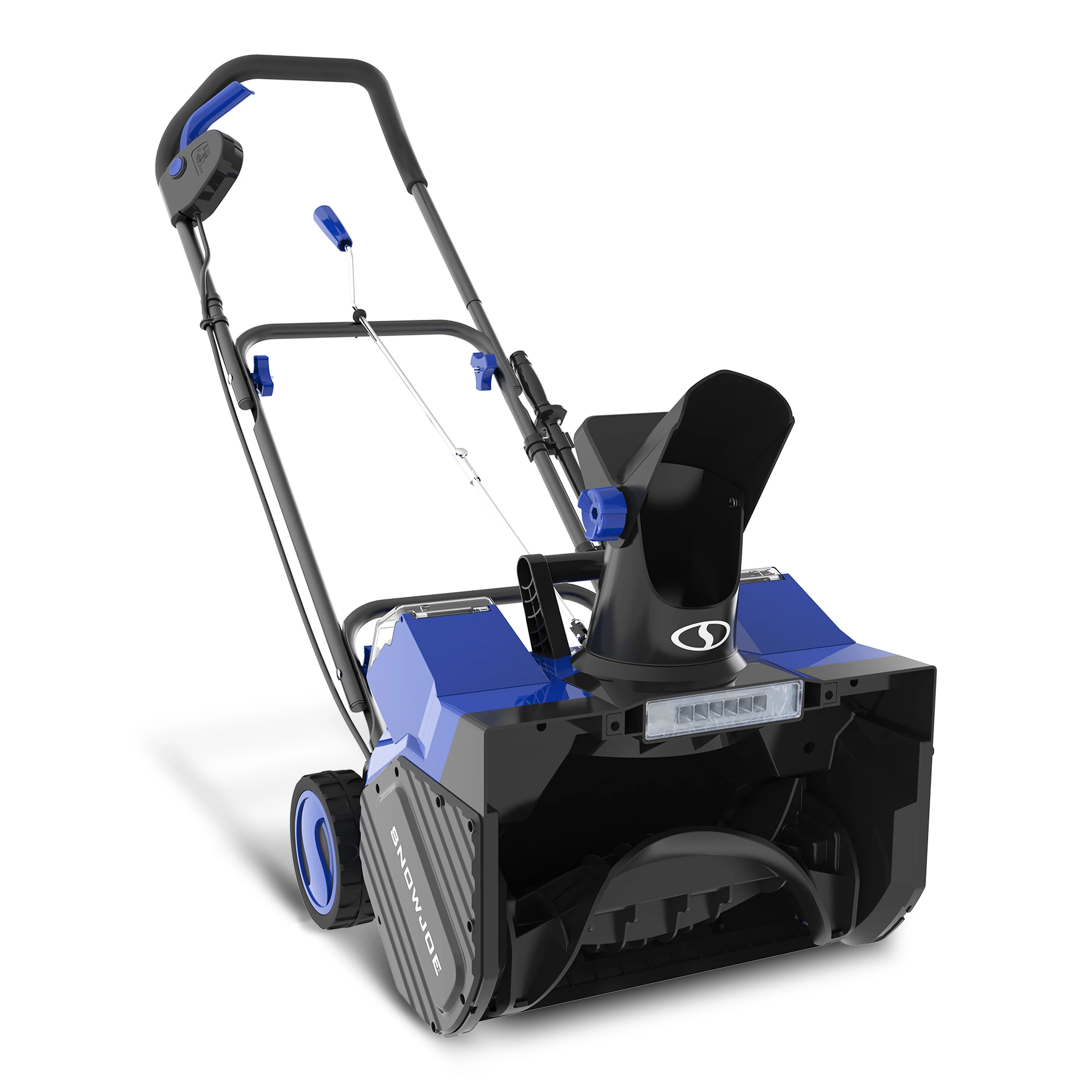
18" wide · 48V (2×24V), 2×4.0Ah batteries · 38 lb
Snow Joe's bread-and-butter cordless kit runs two 24V packs together for 48 volts feeding a 1200W brushless motor, and the pitch — up to 14 tons of snow per charge — mostly holds up as long as the snow is the light, fluffy kind. In 3-6 inches of powder it clears an 18-inch path down to pavement and feels almost effortless at 38 lbs; sidewalks, patios, and one- to two-car driveways are its natural habitat. The catches are the same ones owners flag at Lowe's and in the forums: roughly 30 minutes of real runtime, a 20-foot best-case throw that collapses in wet snow, and slush that packs the small chute until you stop and clear it. Against the Greenworks 80V 20-inch it gives up width and throw but costs about the same with two batteries instead of one, and Snow Joe's 24V packs share with their mowers and trimmers. Skip it in lake-effect country; for a Mid-Atlantic sidewalk-and-driveway routine it's a sensible, genuinely cheap-to-run pick.
Best for Townhouse and small-driveway owners in moderate snow climates who want the lightest credible cordless snow blower.
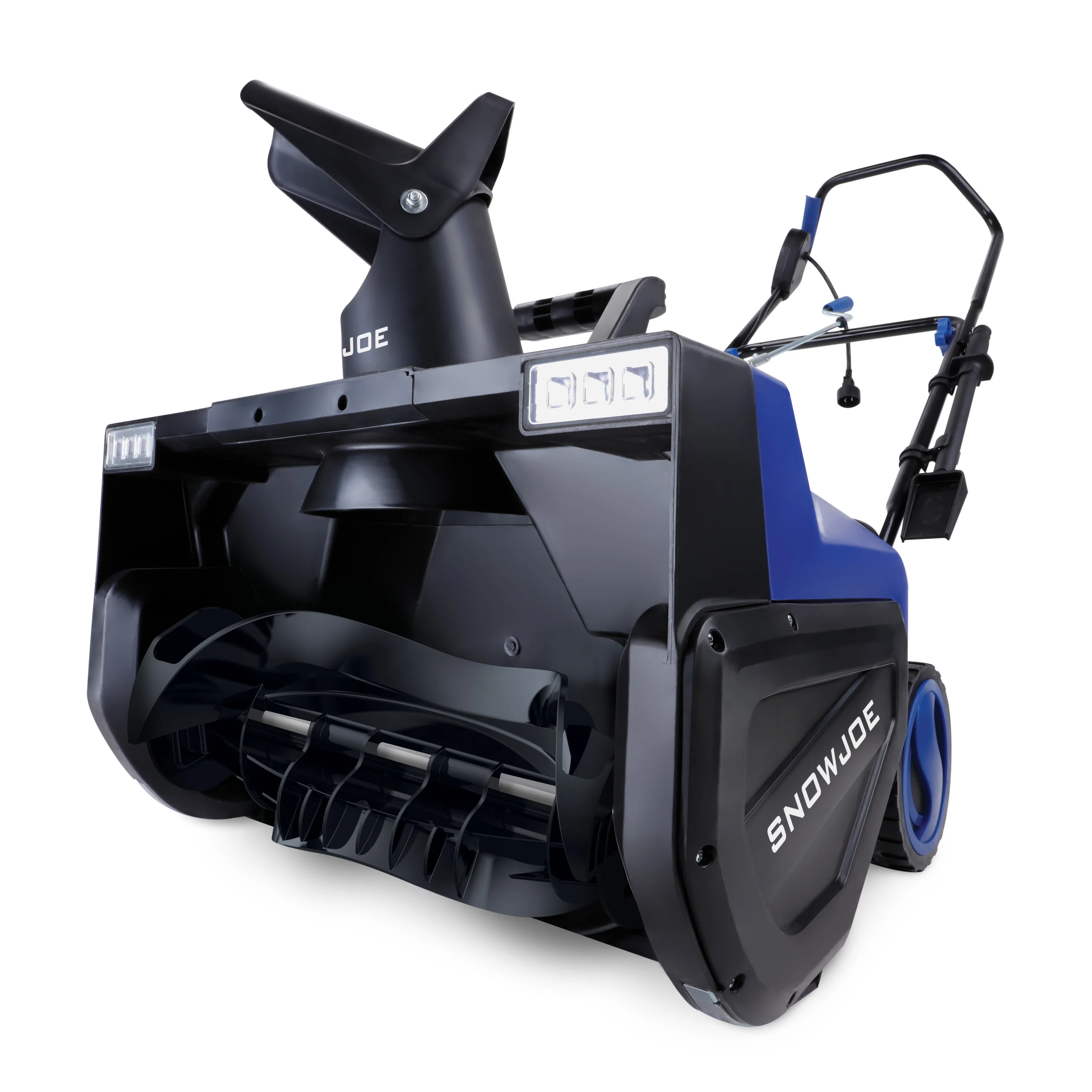
22" wide · 25 ft throw · 35 lb
The SJ627E is the muscle car of corded snow blowers — a 15-amp motor, a 22-inch steel auger, and a 13-inch intake that out-specs every other plug-in on the market, moving a claimed 840 lbs of snow per minute with zero runtime anxiety because the 'battery' is your house. In 6-10 inches of reasonably dry snow it genuinely embarrasses cordless units costing more, and the dual LEDs plus 180° crank chute round out a spec sheet nothing else corded matches. The honest knocks, per its middling 3.9-star Home Depot average: you're tethered to a 12-gauge extension cord you must choreograph around every pass, wet slush overwhelms the chute and drops the 25-foot throw to a sad arc, and some owners report auger belts and plastic chute parts wearing out after a couple of seasons. Against the cheaper WEN 5670 you're paying roughly $80 more for 2 extra inches of width and a deeper intake. For a 50-foot city driveway near an outlet, it's the most power per dollar in snow removal.
Best for Owners of short urban driveways and long sidewalks within cord range who want maximum snow-moving power for around $200.
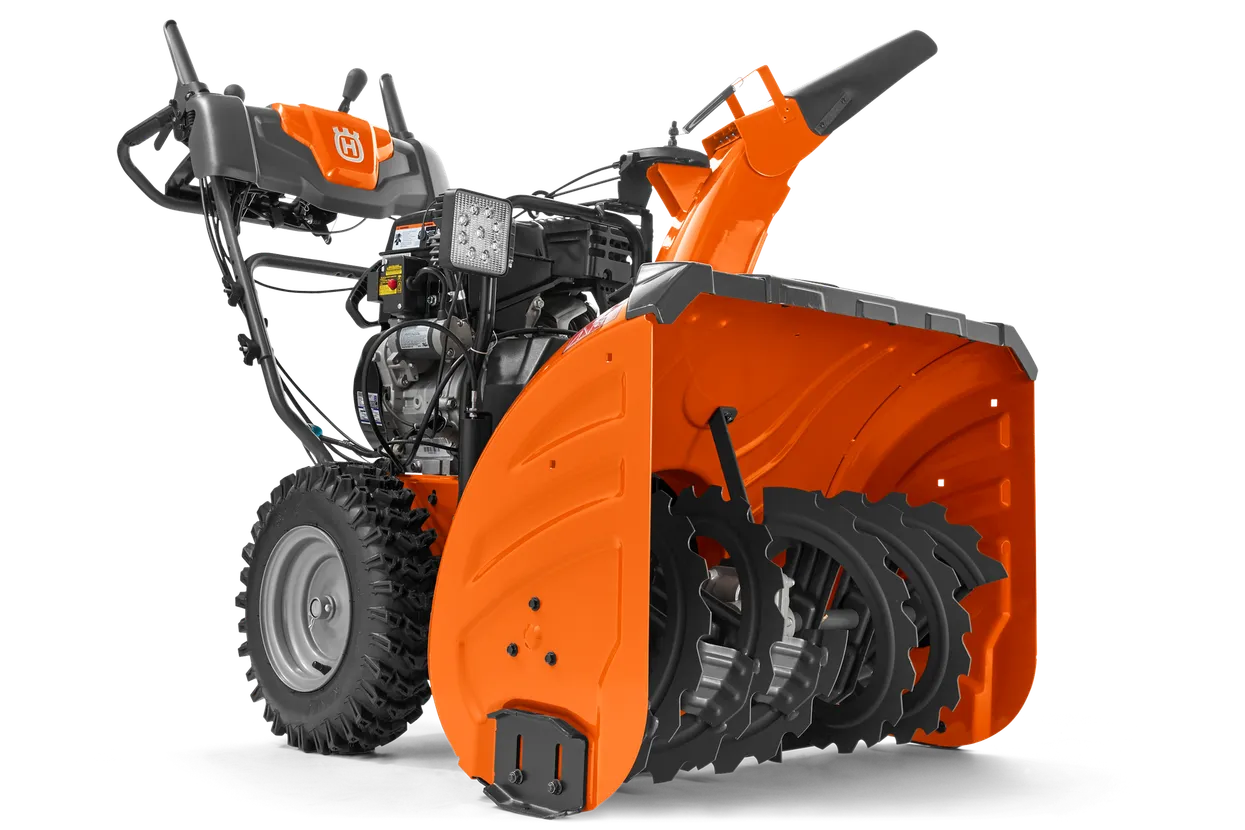
Husqvarna ST 330
~$1,84930" wide · 40 ft throw · 274 lb · heated grips
The ST 330 is Husqvarna's residential flagship: a 389cc engine rated at 11 hp gross, a 30-inch bucket with a 23-inch intake, cast-iron auger box and three-blade impeller, plus the comfort kit — heated grips, LED lights, and a deflector extension in the box. Around $1,849 it plays against the Ariens Deluxe 30 EFI and Platinum 30 SHO, and on paper it gives little away while costing less. The catch is the record: this exact model was in the July 2023 CPSC recall (auger pulley bolt could loosen and lurch the machine into drive — free dealer repair, so verify on leftover or used units), and its 3.4-star average across 17 Acme Tools reviews reflects real grumbles about drive-belt slip in the deepest snow and cables that need seasonal adjustment, alongside genuine praise for the engine's grunt. Owners in the snowbelt who maintain it report it shrugging off two-foot storms; buyers expecting Ariens-grade set-and-forget reliability are the ones who end up disappointed. Strong value, honest flaws.
Best for Heavy-snowfall homeowners with wide driveways who want near-Ariens-Platinum muscle and comfort for hundreds less.

30" wide · 40 ft throw · 288 lb · heated grips
This is Cub Cadet's flagship wheeled three-stage: a 420cc electronically-governed engine, 30-inch heavy-duty 14-gauge bucket, 23-inch intake, heated grips, and a light bar — on paper the biggest residential snow weapon under $2,500. The catch is right in the reviews: 3.4 stars across 165 Home Depot ratings, notably below Cub's own 2X 30 MAX at 4.1. Owners agree it's monstrously powerful in deep cold snow and the 420cc barely notices a full-width bite, but heavy wet conditions expose the three-stage's weakness — packing around the accelerator, frequent shear pin breakage, and chute clogging. That's the owner-forum line on all 3X machines: the third stage adds ingestion speed you'll notice in 18-inch powder and failure points you'll notice in March slush. At $2,349 you're shopping directly against the Ariens Deluxe 30 EFI and Platinum 28 SHO, which the forum crowd takes for durability every time. Buy the 3X 30 HD if you get big, frequent, mostly-dry snowfalls and want maximum speed per pass; buy the Ariens or Cub's 2X 30 if wet snow is your normal.
Best for Large-driveway owners in serious snow country who want the fastest possible clear and mostly see dry snowfalls.
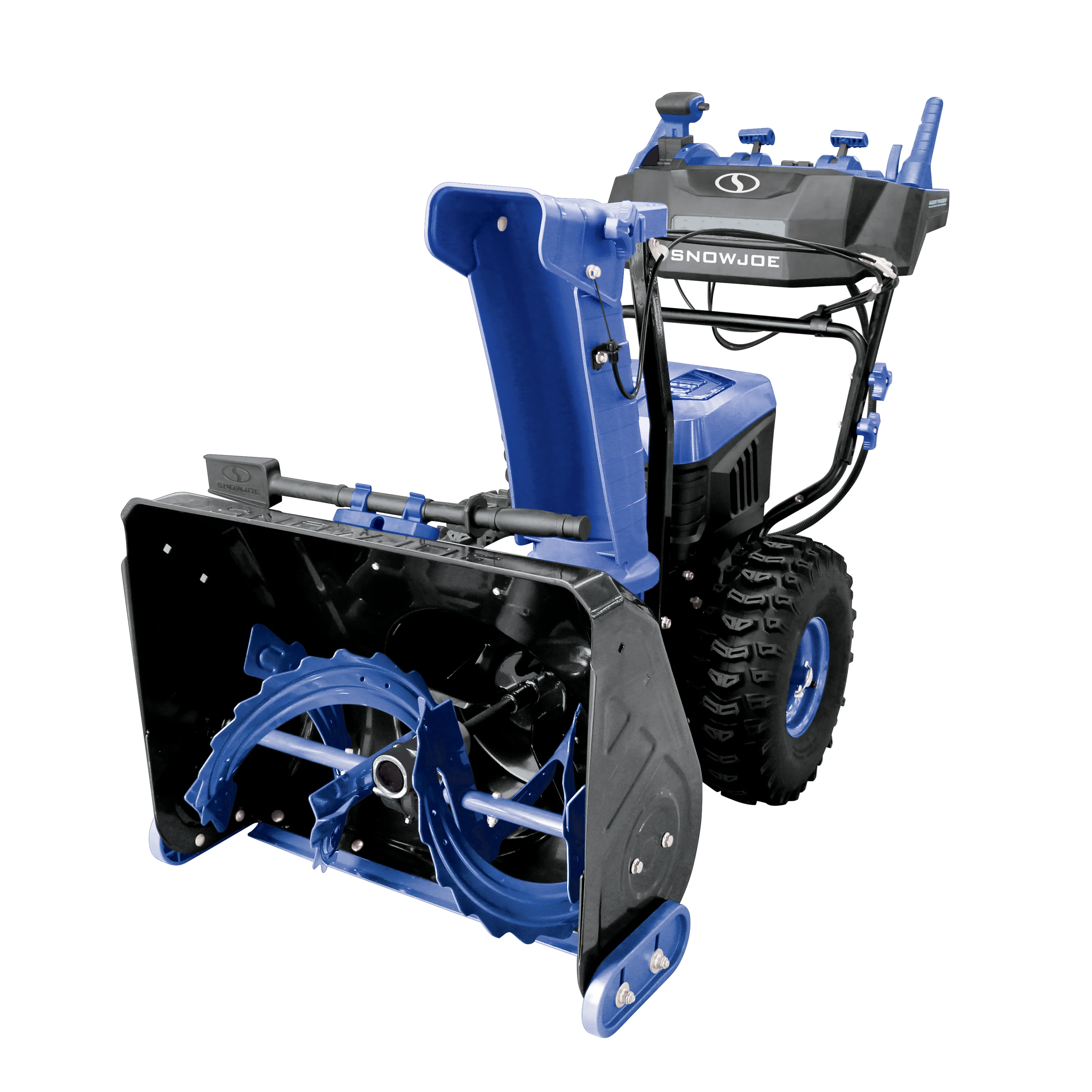
24" wide · 96V max (4×24V), 4×12.0Ah batteries · 148 lb
Snow Joe's flagship stacks four 24V 12.0Ah packs into a claimed 96 volts feeding a 3200W plowing motor plus a 400W drive motor, and on paper it matches the Greenworks 80V 24-inch spec for spec: 24x17-inch mouth, serrated steel augers, 40-foot throw, self-propel with reverse. The reality check is the 3.1-star Lowe's average — owners praise the power in a foot of snow but report drive-system failures, batteries that sulk in deep cold, and slow warranty service, a pattern that echoes across owner threads on Snow Joe's big machines. The four-battery charging routine (two dual-port chargers, staggered swaps) is also more babysitting than one big 80V pack. When it's healthy it clears an 18-inch storm without gas, fumes, or pull cords, and the 148-lb weight is friendlier than the 176-lb Greenworks. But at the same ~$1,800, the Greenworks 2615702 and EGO SNT2405 carry far stronger owner track records — buy this one on a steep discount or not at all.
Best for Battery-first buyers already invested in Snow Joe's 24V system who want two-stage power and can catch it well below list price.

Troy-Bilt Vortex 2610
~$1,72926" wide · 40 ft throw · 280 lb · heated grips
The Vortex 2610 is Troy-Bilt's version of Cub Cadet's 3X 26 — same MTD three-stage architecture with a center accelerator spinning 10x auger speed, a 357cc engine, Touch N' Turn power steering, and heated grips, usually landing $100-200 under the Cub. The value math is tempting; the owner data is a warning. Its Home Depot listing sits at 2.9 stars (small 13-review sample), and the complaints mirror every MTD three-stage: wet snow packs around the accelerator, shear pins snap in crusted drifts, and the extra stage adds clog points a good two-stage doesn't have. Owners' standing advice is to skip the third stage entirely and buy impeller quality — an Ariens Deluxe 28 SHO at similar money, or even Troy-Bilt's own Storm 2890, is the safer machine. Where the Vortex makes its case is cold, dry, deep snow: owners in powder country do report it ingesting 12-18 inch dumps visibly faster than their old two-stages, with the heated grips and trigger steering making long sessions pleasant. It's a conditional recommendation — right climate, wrong slush.
Best for Dry-powder-climate buyers who want three-stage ingestion speed with premium controls at the lowest price for the class.

Ariens Deluxe 28 SHO
~$1,79928" wide · 55 ft throw · 239 lb
The Deluxe 28 SHO has been the enthusiast consensus 'sweet spot' Ariens for a decade — you pay about $150 over the standard Deluxe 28 and get the Super High Output impeller setup that spins a 14-inch impeller off a higher-torque engine, moving a rated 72 tons per hour and throwing heavy snow a genuine 50-55 feet. The current 921072 swaps the old LCT 306cc for a new 301cc AX, and forum owners report it 'starts in two pulls or less and shoots snow wherever you want,' though a vocal minority wishes Ariens had put the 389cc on it. Build is classic Ariens: steel everywhere, cast-iron gear case, dual-belt drive. The knocks: handwarmers went from standard to optional on this generation (a genuine downgrade at $1,799), and Auto-Turn still wants properly set skids on gravel. Compared to a Toro Power Max HD 828, the Toro has nicer chute ergonomics; the Ariens out-throws it and holds value better. It's the machine for 2-3 car driveways in lake-effect and Nor'easter country, and the one Ariens dealers themselves most often recommend.
Best for Larger two-to-three-car driveways in heavy-snow regions where throw distance and wet-snow capacity justify the SHO premium.
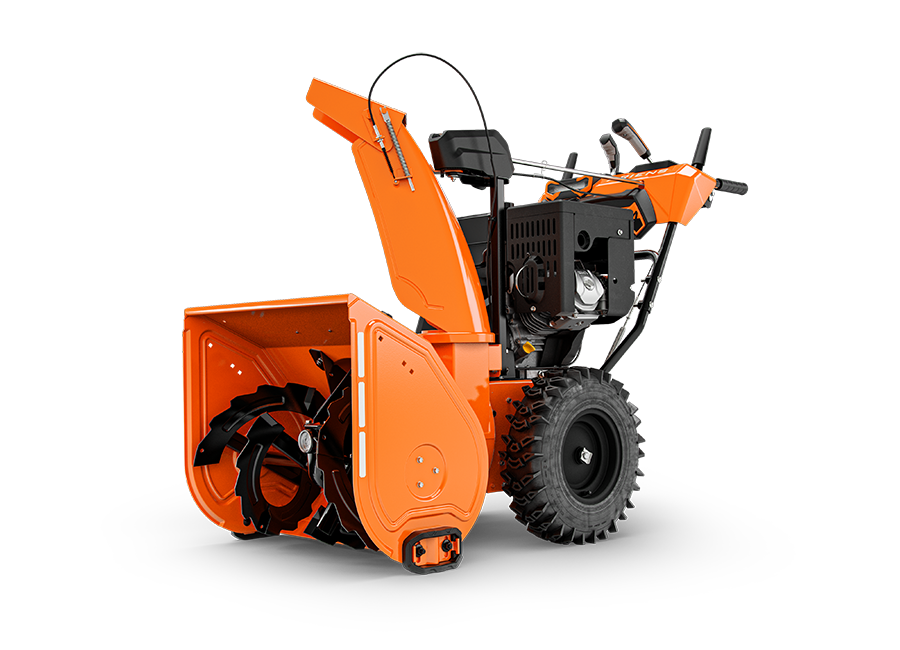
Ariens Platinum 24 SHO
~$1,99924" wide · 55 ft throw · 267 lb · heated grips
The Platinum 24 SHO is the classic 'small bucket, huge engine' play: the current 921074 hangs a 389cc AX — the same displacement class as machines a foot wider — on a 24-inch housing with the Super High Output impeller, and the result is a rated 73 tons per hour and 55-foot throws that simply don't slow down in wet, knee-deep snow. This is the machine snowblower forums recommend for lake-effect and mountain-town driveways too narrow or steep for a 28. You also get the comfort kit the Deluxe line lost: standard heated handgrips, LED light, and one-hand interlock. Two honest gripes: Ariens dropped the old EZ-Launch EFI engine (the discontinued 921053 started easier at altitude and sipped less fuel — the new carbureted 389 is stronger but thirstier), and at $1,999 you're paying Deluxe 30 money for a 24-inch cut. At 267 lb it's dense but Auto-Turn keeps it nimble. Versus a Toro Power Max HD 828 OAE, the Ariens throws farther and feels more overbuilt; the Toro clogs marginally less. For deep-snow owners who prioritize power density over width, this is the one.
Best for Short, narrow, or steep driveways in extreme-snow regions — lake-effect and mountain towns where power matters more than width.
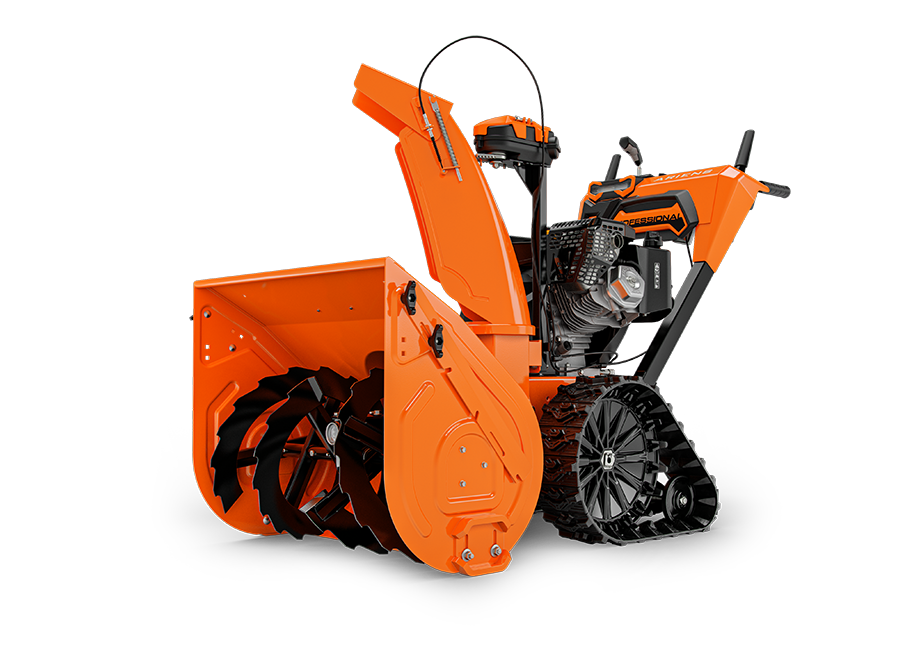
28" wide · 60 ft throw · 339 lb · heated grips
This is the machine the forum flex threads are about: a commercial-grade 420cc AX engine, a 23.5-inch-tall Pro bucket with 16-inch serrated augers, hydrostatic drive, and Ariens' party trick — RapidTrak, a track system that flips between wheel-speed mode, full track mode for slopes, and a dig-in mode that rotates the housing down to shave hardpack. Owners describe standing at the end-of-driveway berm and simply driving through it while neighbors rock their wheeled machines back and forth; the hydro lets you feather speed to exactly what the snow allows, and it moves a rated 79 tons per hour with 60-foot throws. Reported warts: it does a poor job scraping packed tire tracks (the tracks ride up), a few owners have chased drive-skipping under heavy load, the track hardware is exposed to slush, and at 339 lb and $3,199 it's double the cost of a Deluxe 28 SHO that clears the same width. Buyers are steep-driveway owners, heavy lake-effect victims, and people who plow for elderly neighbors half the block.
Best for Steep, long, or brutal-snow driveways — the buy-once machine for people who clear multiple properties or face 2-foot lake-effect dumps.

22" wide · 30 ft throw · 93 lb
The 1022ER is the sleeper value in single-stage: Briggs' own 950 Snow Series 208cc engine — factory-rated to fire down to 20 below zero — in a 22-inch machine that undercuts an Ariens Path-Pro by a solid $50-100 while clearing an inch wider. Reviewers repeatedly note it 'works like a two-stage' in wet snow, which is the 208cc doing what the 123cc engines in cheaper single-stages can't, and the remote chute rotation (the 'R' in the name) means you're not stopping to muscle a chute like on the base 1022E. Owner gripes are specific: the thermoplastic auger leaves a thin film on ice-glazed pavement, a handful of owners report the drive belt walking off and being fiddly to re-seat, the manual is famously bad, and stock is genuinely hard to find some winters since B&S's 2020 restructuring thinned distribution. There's no headlight and nothing is heated. But for a sub-$700 machine handling 6-12 inch storms on a one-or-two-car paved driveway, it's the strongest honest-value play against the Toro Power Clear 721 E, which costs more for similar output.
Best for Budget-minded owners with one-to-two-car paved driveways and 6-12 inch storms who still want a big engine and remote chute.

Briggs & Stratton 1227MD
~$1,09927" wide · 40 ft throw · 205 lb
The 1227MD (sold in current production with S1227 badging) is the value counterpunch to the $1,650 Ariens Deluxe 28: a 27-inch steel bucket, notched steel augers, aluminum gear box, and Briggs' own 1150 Snow Series 250cc engine — cold-rated to 20 below — for roughly $500 less. Owners consistently say it has 'plenty of power to throw snow, even wet snow,' and its 40-foot rated throw holds up in real use; the Free Hand control that lets you crank the chute while still driving is a genuinely good piece of design. What you give up versus the name brands is refinement and serviceability: there's no trigger or power steering, so the solid axle makes end-of-pass turns a workout on a machine this size; heated grips and power steering are reserved for the pricier 1227MDS; and one recurring owner complaint is that pulling the impeller/wheels for service requires a bearing puller most homeowners don't own. As a straightforward, well-powered two-stage for average Midwest winters at a near-Costco price, though, it's one of the best honest values in the 27-inch class.
Best for Value-focused owners with two-car driveways in average snow regions who want name-brand-engine power without the $1,600+ price of an Ariens or Toro.

Toro Power Max 826 OHAE
~$1,49926" wide · 45 ft throw · 194 lb · heated grips
The 826 OHAE is the sweet spot of Toro's two-stage line and the machine most often cross-shopped against the Ariens Deluxe - the forum verdict is that you can't go wrong either way, but the Toro's Quick Stick chute control beats Ariens' crank and it typically costs a few hundred less. Same proven 252cc four-stroke as the 824 OE, but the extra $100 buys the stuff you actually feel: triggerless Auto Steer that unlocks the inside wheel when you tip into a turn, hand warmers, an LED light for 6 a.m. storms, and a 26-inch bucket. The Anti-Clogging System meters intake so wet lake-effect snow keeps moving, and there are no shear pins - the engine stalls on impact by design, which owners initially distrust and later brag about. Honest knocks: 194 pounds is real weight when the drive is disengaged, friction-disc speeds need occasional cable adjustment, and the poly upper chute looks ordinary at this price. At $1,499 with a 45-foot throw and 20-inch intake, it's the default recommendation for anyone clearing a four-plus car driveway in serious snow country.
Best for The snow-country homeowner who wants the full comfort package - auto-steer, heated grips, headlight - at the mid-tier price.
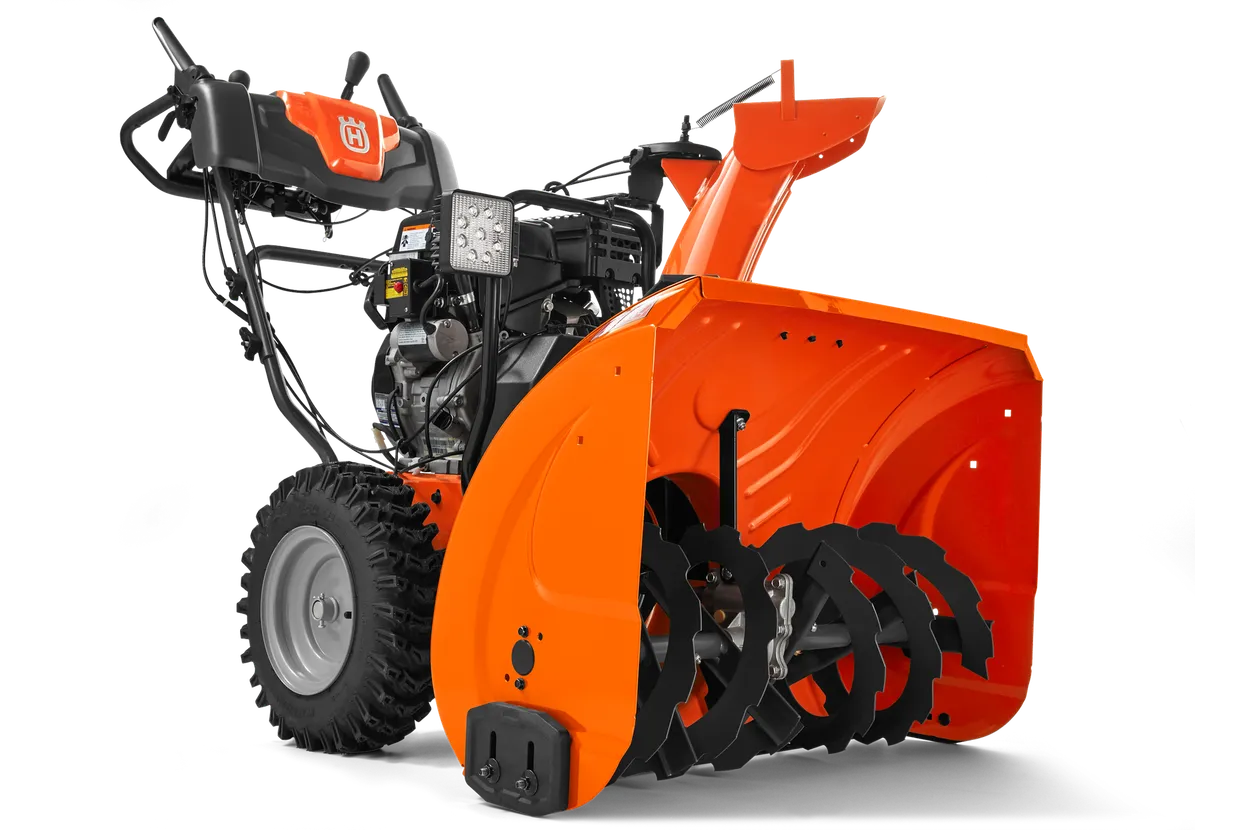
Husqvarna ST 230
~$1,49930" wide · 40 ft throw · 239 lb
The ST 230 is Husqvarna's play for people who want a 30-inch cut without paying Ariens Deluxe 30 money — at $1,499 it undercuts that rival by several hundred dollars while packing a 301cc engine, power steering, LED lights, and a 23-inch intake that swallows plow drifts. The current generation (redesigned in 2023) fixed some sins of the old ST230P, but forum and retailer sentiment on this family is genuinely mixed: owners love the throwing power and the four-position adjustable handle, while critics pile on the friction-disc drive that can slip in deep snow, plastic cable pivots that fail out of warranty, and chute rotation that feels vague next to an Ariens crank. Husqvarna also dropped the heated grips the old P models had, which stings at this price. If you get a good one — and plenty of people do — it's a lot of machine for the money; just budget an hour each fall for belt, cable, and skid-shoe checks, and know the Ariens holds resale better.
Best for Large two-to-three-car driveways in moderate-to-heavy snow country where budget matters more than brand cachet.
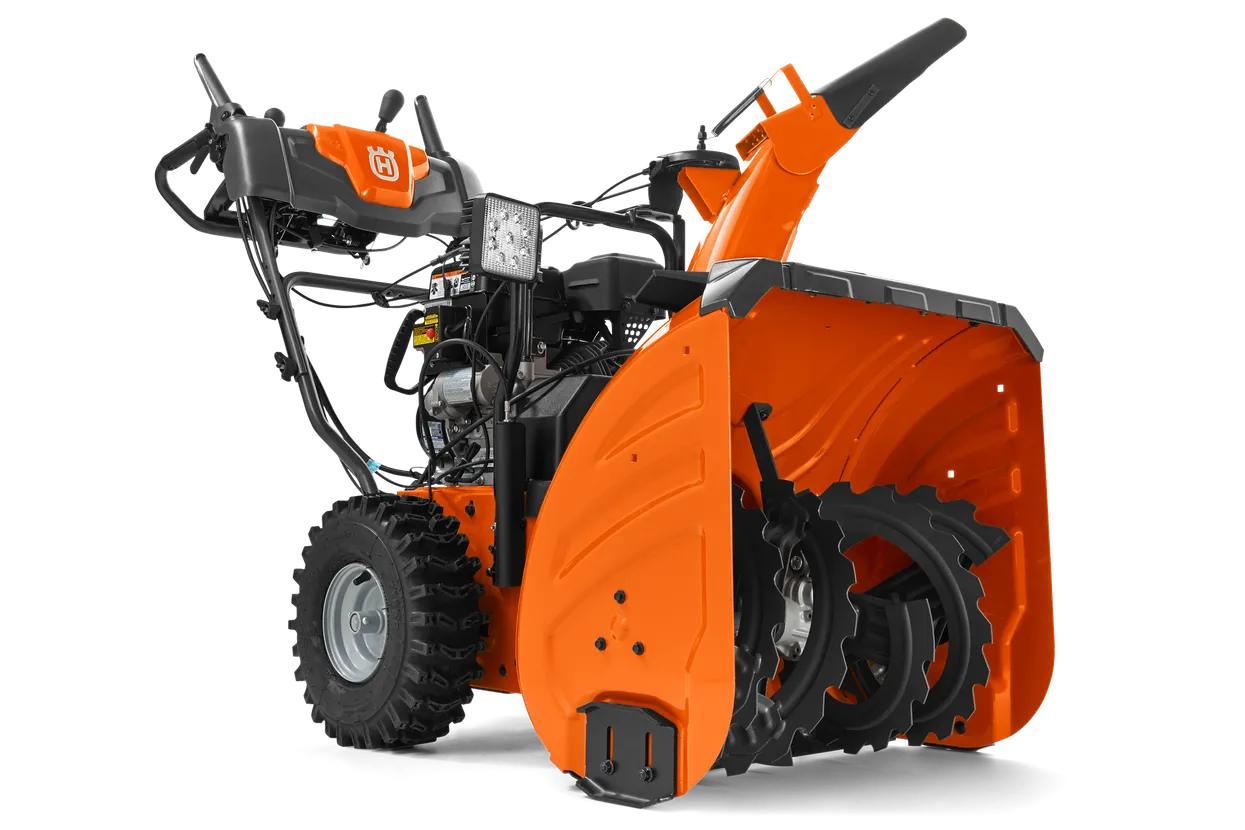
Husqvarna ST 327
~$1,69927" wide · 43 ft throw · 253 lb · heated grips
The ST 327 is the sweet spot of Husqvarna's 300-series — a 27-inch machine with the same 301cc engine as the 30-inch ST 230 but with heated grips, a cast-iron three-blade impeller, and a stouter belt system, hands-on testers have measured it launching snow up to 43 feet. Consumer Reports rated the previous 227/327 generation very good for plow piles, throwing distance, and handling, and that DNA carries over. The honest caveats: early units (sold July 2022 to February 2023) were part of a CPSC recall for an auger pulley bolt that could loosen and lurch the machine into drive — Husqvarna dealers fix it free, but check the serial on any leftover stock. Beyond that it's the usual Husqvarna story: excellent spec-per-dollar at $1,699 versus an Ariens Deluxe 28 SHO at $2,000+, offset by a friction-disc drive and cable hardware that demand seasonal attention and a dealer network thinner than Ariens' in some snow states.
Best for Snowbelt homeowners with medium-to-large driveways who want 300-series muscle and comfort features without Ariens pricing.
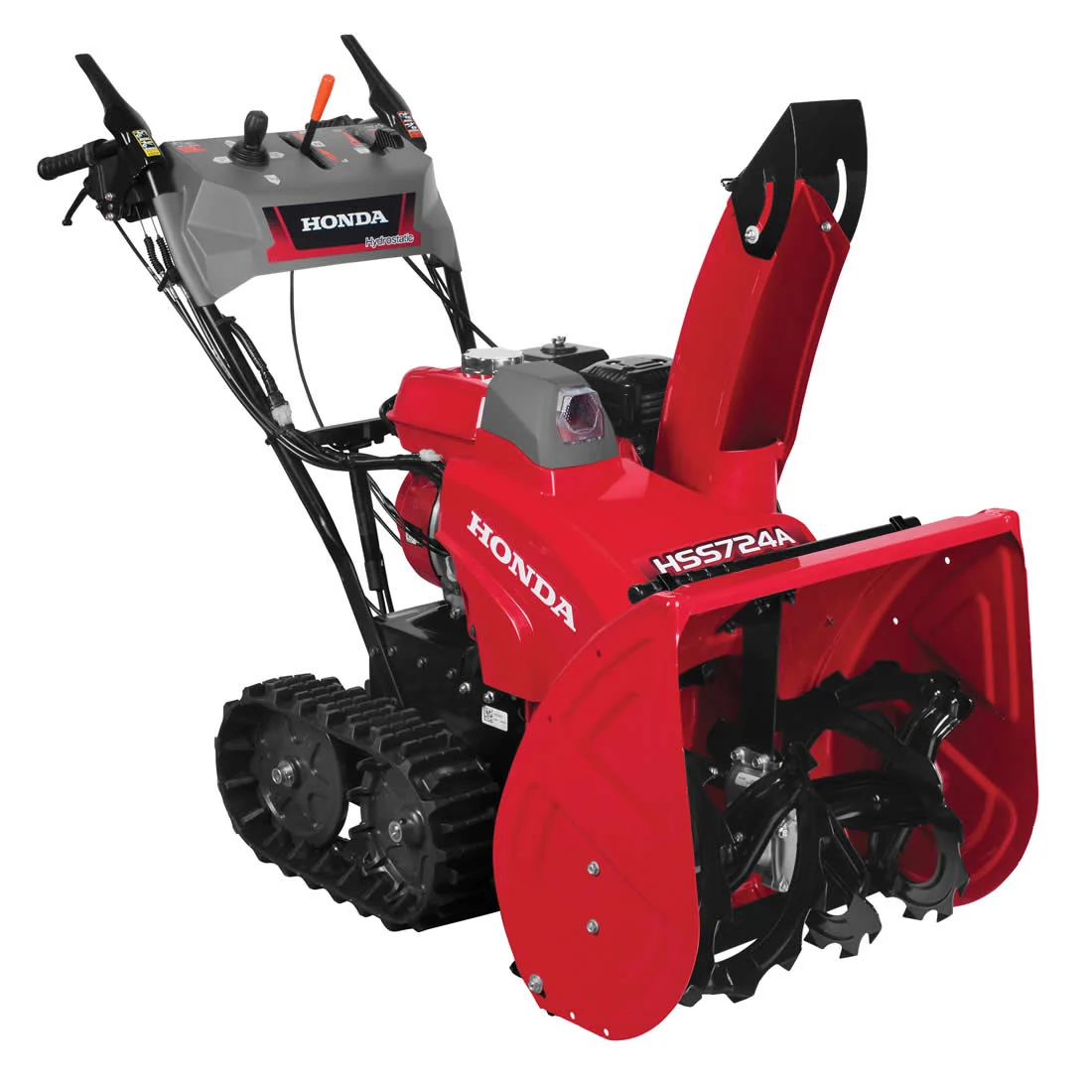
Honda HSS724ATD
~$3,29923.8" wide · 49 ft throw · 243 lb
This is the smallest of Honda's track-drive HSS line, and the one owners point slope-dwellers to when wheels just spin: hydrostatic tracks claw up steep or gravel driveways, the auger height lever lifts the bucket clear of loose stone, and the GX200 engine is the same commercial mill that runs rental fleets for decades. Owner sentiment is near-reverent about build quality — 'Honda smooth' comes up constantly — but you must know the history: 2015-era HSS machines had a well-documented chute-clogging saga in wet snow, and Honda's fix was a redesigned, larger-opening chute available free under warranty (current production has it baked in). The other rub is price: at roughly $3,299 you're paying Ariens Platinum 24 SHO money plus a thousand bucks for a 23.8-inch cut, and Honda has exited single-stage snow blowers entirely in the US, so dealer support is the bet you're making. For deep-snow country on a grade, though, nothing this size works like it.
Best for Steep, icy, or gravel driveways in serious snow country where traction and longevity outrank width-per-dollar.
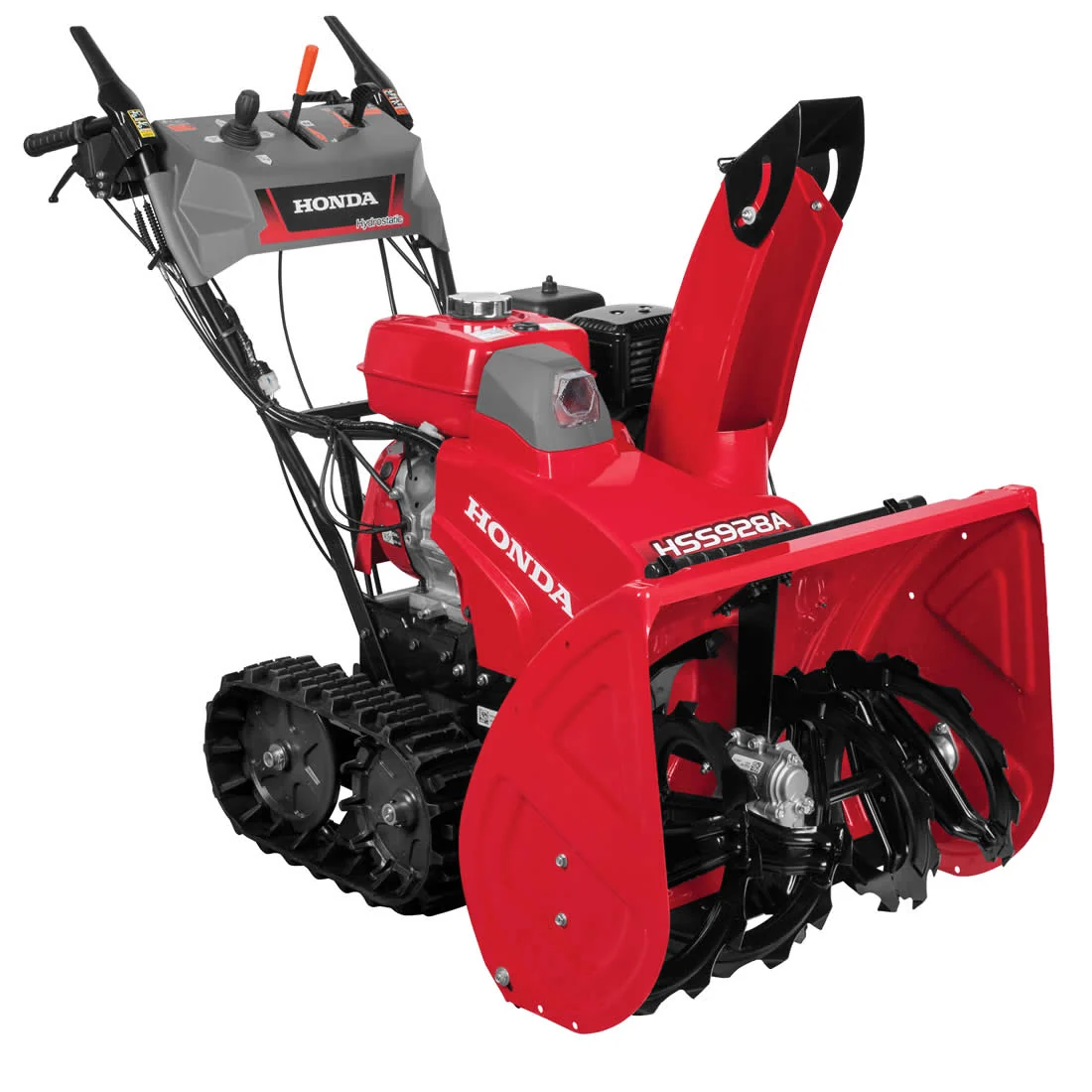
Honda HSS928ATD
~$3,59928" wide · 52 ft throw · 276 lb
The HSS928ATD is the Goldilocks of Honda's track line and the model snowblowerforum lifers usually mean when they say 'just buy the Honda': a GX270 pushing 1,900 lb/min through a 28-inch bucket, hydrostatic tracks that hold a grade like a tank, and joystick chute control that owners describe as fantastic. Home Depot reviewers call it 'easily the best snowblower made,' and the engine routinely outlives the driveways it clears. Honesty file: this platform was at the center of the HSS wet-snow clogging saga — Honda's redesigned larger-opening chute (free under warranty, standard on current units) mostly settled it, but heavy slush can still slow the 270cc more than the bigger HSS1332. At about $3,599 it costs $1,300+ more than an Ariens Platinum 24 SHO and turns slower than Ariens' auto-turn wheels, yet nothing in the price class matches its traction or fit-and-finish. With Honda winding down parts of its US power-equipment line, grab one while dealer channels are still full.
Best for Heavy-snowbelt homeowners with sloped or gravel driveways who want a buy-once machine and can stomach the price.
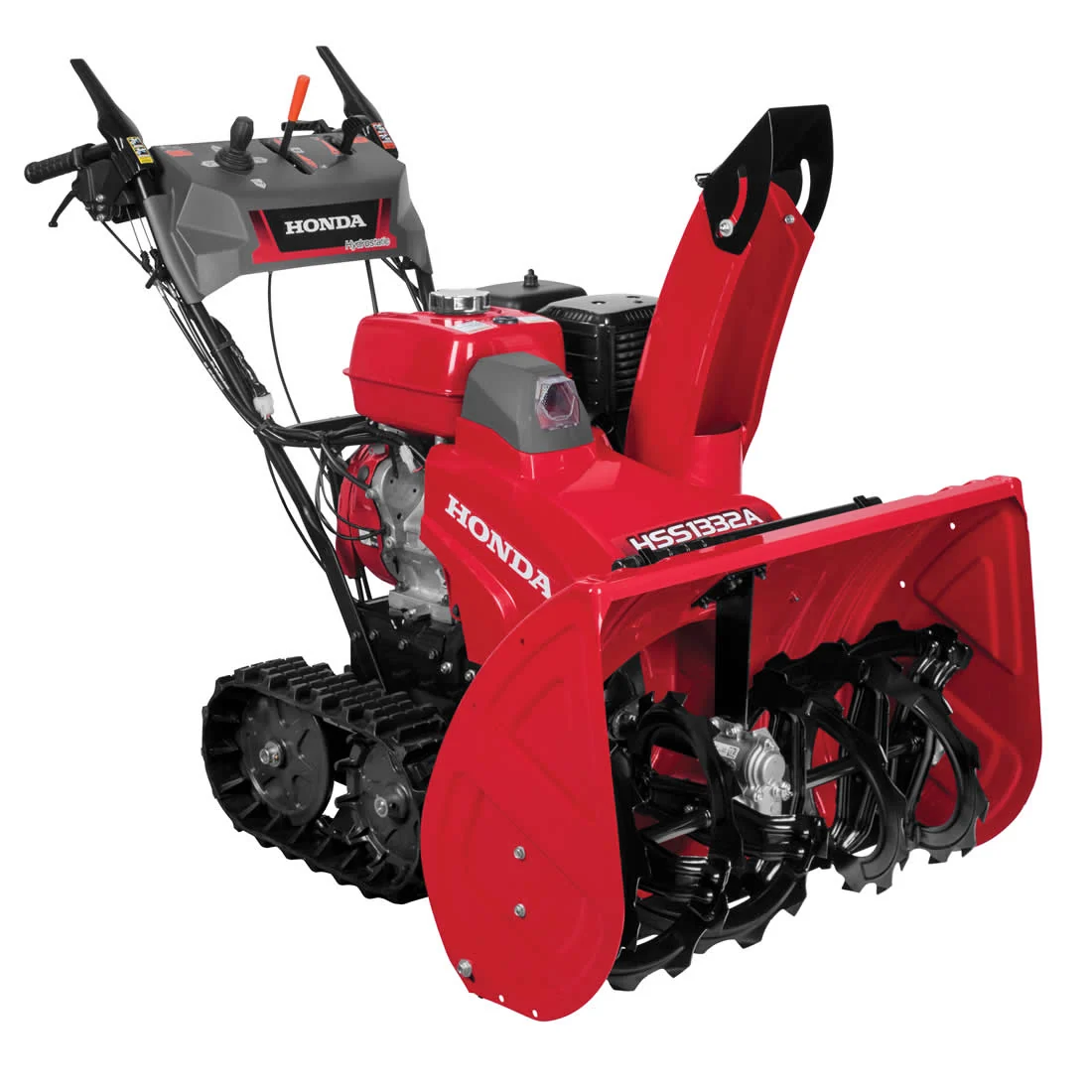
Honda HSS1332ATD
~$3,99931.9" wide · 56 ft throw · 298 lb
This is the biggest gas snow blower Honda sells in the US and the machine snowblowerforum threads simply call 'awesome': a GX390 moving 2,750 lb/min through a 32-inch bucket with a 56-foot throw that reviewers joke puts snow in the neighbor's yard. Notably, the wet-snow clogging complaints that dogged the HSS928 barely touched this model — the bigger impeller and 389cc of torque keep heavy slush moving, and current units carry Honda's redesigned chute anyway. Owners' actual gripes are practical: it's 298 lb, it fills half a shed, turning the tracks takes shoulders since there's no trigger steering, and at about $3,999 it's up against the Ariens Platinum 30 SHO and Professional RapidTrak, which cost less and steer easier. But for lake-effect country, long steep gravel drives, or anywhere the plow leaves a four-foot wall, this is the no-drama pick — commercial-grade everything, decade-plus service life, and traction that makes chains-on-wheels rivals look silly.
Best for Lake-effect and mountain-country properties with long, steep, or gravel driveways and routinely deep, heavy snow.
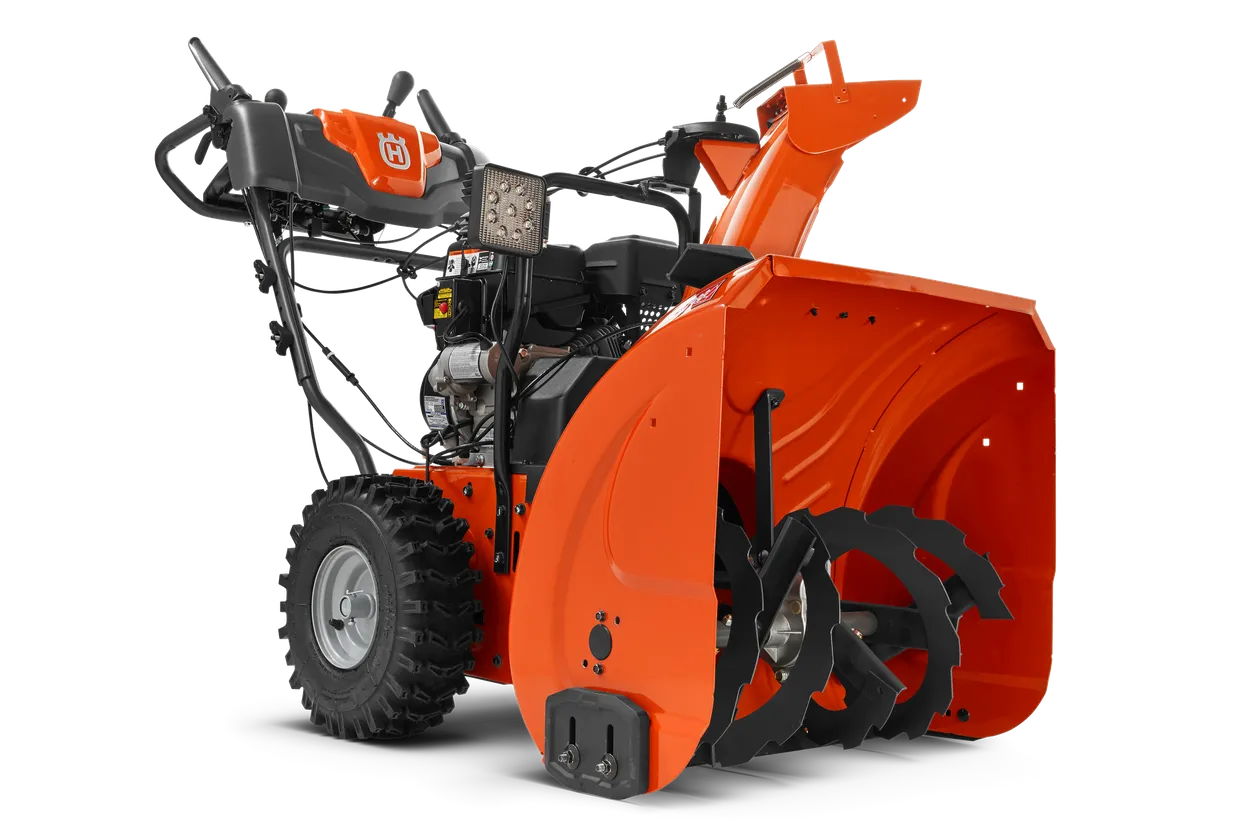
Husqvarna ST 224
~$1,09924" wide · 35 ft throw · 206 lb
The ST 224 has been Husqvarna's volume seller for a decade, and the current version quietly fixed the old model's biggest gripe by adding trigger power steering as standard. It's the classic first two-stage: 24-inch cut, 23-inch intake, 212cc engine that starts on the first pull (owners brag about this constantly), and a hands-on tested throw of 30-35 feet — good with powder, adequate with wet cement-snow. Around $1,099 it sits between MTD-built box-store machines and the Ariens Compact 24, and that's exactly how the ownership experience reads: sturdier auger housing and a 10-year cast-iron gearbox warranty on one hand; a friction-disc drive, stretchy control cables, and plasticky chute hardware that generate most of the complaints on the other. Note that heated grips, which the old Lowe's-era 224 had, are gone from the current spec. Treat the first-season belt adjustment as scheduled maintenance and it'll clear a two-car driveway for years without drama.
Best for First-time two-stage buyers with a standard two-car driveway and regular 6-14 inch snowfalls.
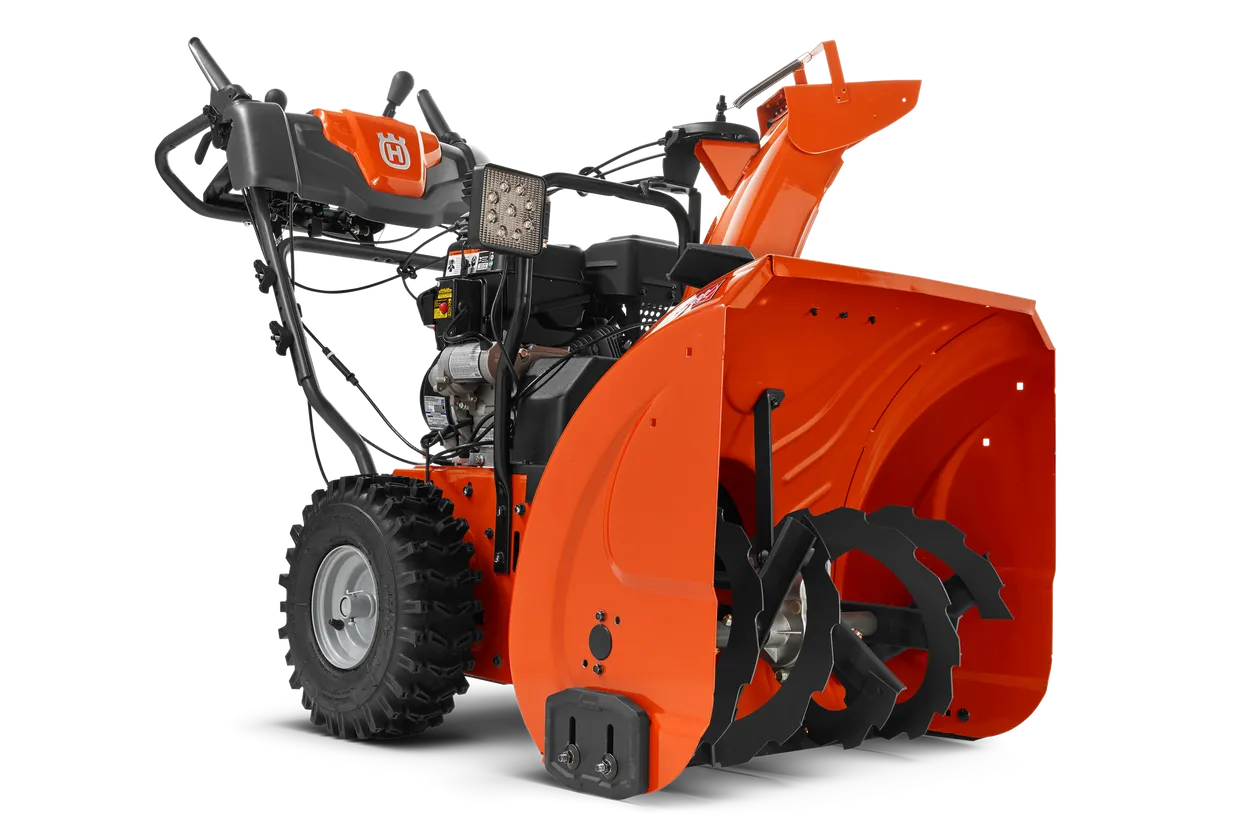
Husqvarna ST 227
~$1,29927" wide · 40 ft throw · 212 lb
The ST 227 is the quiet overachiever in Husqvarna's lineup — Consumer Reports scored the previous generation very good for plow piles, throwing distance, surface cleaning, and handling, and this 254cc version keeps that recipe: 27-inch cut, 23-inch intake, power steering, and only 212 lb to push around, barely more than the 24-inch model. At about $1,299 it substantially undercuts the Ariens Deluxe 28 while clearing nearly as wide a path, which is why value-hunters on the forums keep landing here. The trade-offs are familiar Husqvarna: the friction-disc drive is the weak link owners baby (one aging rubber disc is a $40 part but a knuckly job), control cables stretch, and the current generation dropped the heated grips the old ST 227P included — you have to jump to the 300-series to get them back. If your snow is regular but rarely apocalyptic, this is arguably the smartest width-per-dollar buy in the whole Husqvarna range; just do the fall belt check religiously and keep a spare set of shear pins in the toolbox.
Best for Value-focused homeowners with wide driveways or long sidewalks in moderate snow zones who don't need comfort extras.
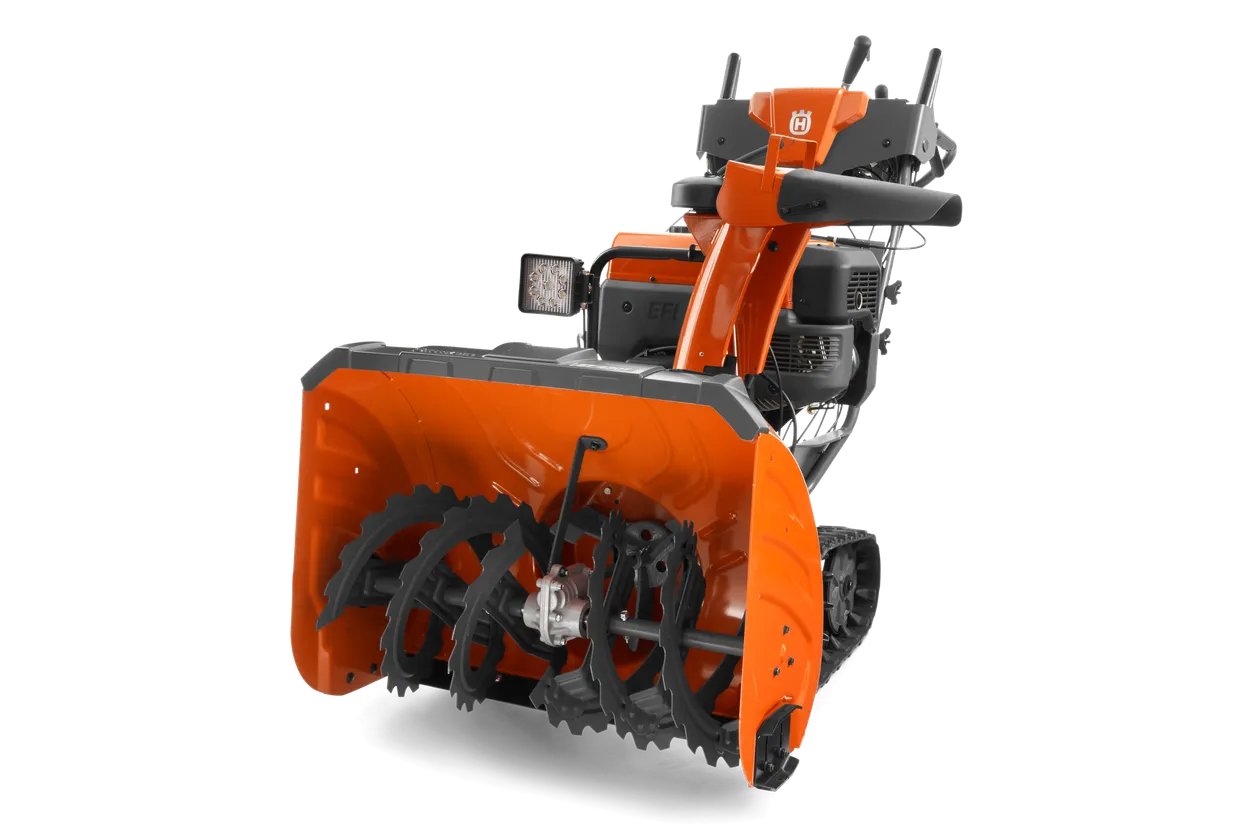
Husqvarna ST 424T
~$2,89924" wide · 40 ft throw · 352 lb · heated grips
The ST 424T is Husqvarna's current 400-series commercial track machine and its most direct shot at the Honda HSS724ATD — same 24-inch class, same hydrostatic-track formula, but roughly $400 less at about $2,899, and it counters with things Honda skips: electronic fuel injection for reliable cold starts and altitude compensation, factory heated grips, an all-steel control console, and trigger power steering so the tracks turn without wrestling. The 301cc EFI engine and cast-iron impeller are rated for commercial duty, and reviewers consistently single out how confidently the tracks climb steep, deep-drifted driveways. The honest counterpoints: at 352 lb it's the heaviest machine in its width class by a wide margin, the 400-series is too new to have Honda's decades-deep reliability record or resale value, published owner reviews are still scarce, and it's dealer-channel equipment, so parts support depends on your local pro dealer. If you like the Honda track concept but want EFI, warm hands, and easier steering for less money, this is the modern pick.
Best for Steep, long, or gravel driveways — and light commercial use — where a Honda track machine is the alternative but EFI and easier steering appeal.

Cub Cadet 1X 21 LHP
~$89921" wide · 25 ft throw · 103 lb
This is the single-stage Cub Cadet you buy when you want premium touches without stepping up to a two-stage. The 208cc engine is noticeably stronger than the 123-179cc motors on cheaper 21-inch machines, and owners consistently call it powerful yet light and easy to use, with snow flying 20-25 feet without jamming. What separates it from a basic Toro or Craftsman is the remote single-lever chute and pitch control plus the in-dash LED headlight — you redirect snow on the move instead of stopping to crank. Honest knocks: it's $899, which is deep into two-stage territory (a Troy-Bilt Storm 2425 costs only ~$330 more), the 13-inch intake means it taps out around 6-8 inches of snow, and like every single-stage it throws slush poorly and scrapes to bare pavement only on smooth surfaces. It's the pick for paved 2-car driveways in 3-8 inch snow country where storage space and maneuverability matter more than blizzard capacity. Against Toro's Power Clear 821, you're trading Toro's proven paddle design for better controls and a 3-year warranty.
Best for Homeowners with a paved two-car driveway who want single-stage simplicity with big-machine controls.

Cub Cadet 3X 26 IntelliPOWER
~$1,59926" wide · 40 ft throw · 270 lb · heated grips
The 3X 26 adds Cub Cadet's patented third stage — a center accelerator spinning 10x faster than the augers — to a 357cc IntelliPOWER engine, and the honest question is whether that's worth it. Owners are openly skeptical: the forum consensus is that a strong engine and a good impeller (read: Ariens SHO) beat a third stage, and owner reviews back the doubters up. Five-year owners call it 'a beast' that out-throws any two-stage they've had, but the loudest complaints are specific: heavy wet snow packs between the accelerator blades, shear pins snap constantly (one owner claims hundreds over five years), and some say the design leaves snow ribbons at the edges. Where the 3X genuinely earns its keep is cold-climate deep powder — 12-18 inch storms where its faster ingestion is real. If your snow is Great Lakes fluff, it clears noticeably quicker than a 2X 26; if you get Northeast slush, the extra moving parts are extra clog points, and an Ariens Deluxe 28 SHO or Cub's own 2X 30 MAX at the same money is the safer buy. Heated grips and power steering are standard.
Best for Deep-snow homeowners in dry-powder climates who want two-stage width with faster ingestion — and accept extra complexity.

Troy-Bilt Storm 2425
~$1,22924" wide · 40 ft throw · 208 lb
The Storm 2425 is Troy-Bilt's entry two-stage and one of the cheapest name-brand paths to real auger-and-impeller snow clearing. The formula is simple: a 208cc engine, 24-inch bucket, 20-inch intake, and the Just One Hand control layout that lets you adjust the chute mid-pass — a feature bargain machines skip. Owner sentiment on the Storm line is steady rather than glowing: it starts easily, handles 8-12 inch storms fine, and the lifetime chute warranty is a nice touch, but the 208cc is the smallest engine you'll find pushing a 24-inch bucket, so wet heavy snow forces half-width bites, and there's no power steering, headlight, or heated grips at $1,229. The owner-forum framing is blunt: this is an MTD value machine — the same bones as a Craftsman 24 — so buy it for the price and the dealer network, not for heirloom durability; an Ariens Compact 24 costs ~$100-200 more and out-muscles it with a 224cc and better build. For light-to-moderate snow regions where the driveway is two cars and the budget is firm, it's a sensible, honest workhorse.
Best for Budget buyers in moderate snow regions who want name-brand two-stage basics on a two-car driveway.
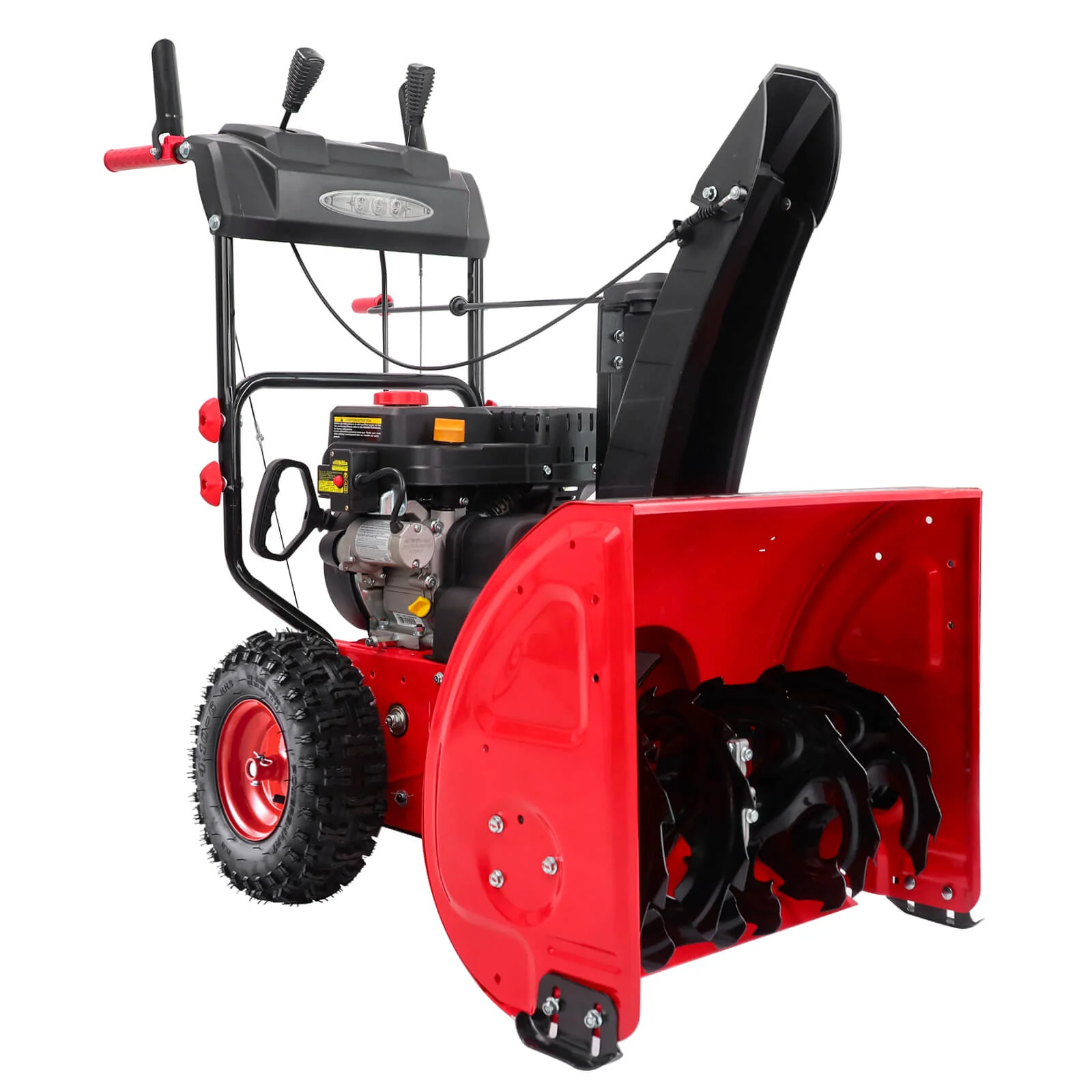
24" wide · 40 ft throw · 187 lb
The PS24 (long sold as the PSSAM24) is the budget disruptor of the two-stage world — a Chinese-built 212cc 24-incher that routinely sells for half the price of a Troy-Bilt Storm 2425 and a third of a Cub Cadet 2X 26. Amazon owners hold it at 4.1 across 470+ ratings, and the sentiment is remarkably consistent: it assembles in half an hour, starts easily on the 120V plug-in, and genuinely moves 8-12 inches of snow — several owners are surprised it handles wet snow at all. The honest knocks are why it's cheap: the steel is thinner (housing corners can bend during assembly), the chute-gear lock nut backs off until you Loctite it, choke levers snap, and parts/customer support is the horror-story section of every review thread. The owner-forum verdict: a lot of machine for the money, zero heirloom potential — ideal as a first blower or rental-property unit. If you clear 60+ inches annually or expect decade-long service, spend up for the Troy-Bilt or Ariens; if you need two-stage capability for the price of a good single-stage, nothing touches it.
Best for First-time or budget buyers in lighter snow regions who want two-stage capability at the absolute lowest price.
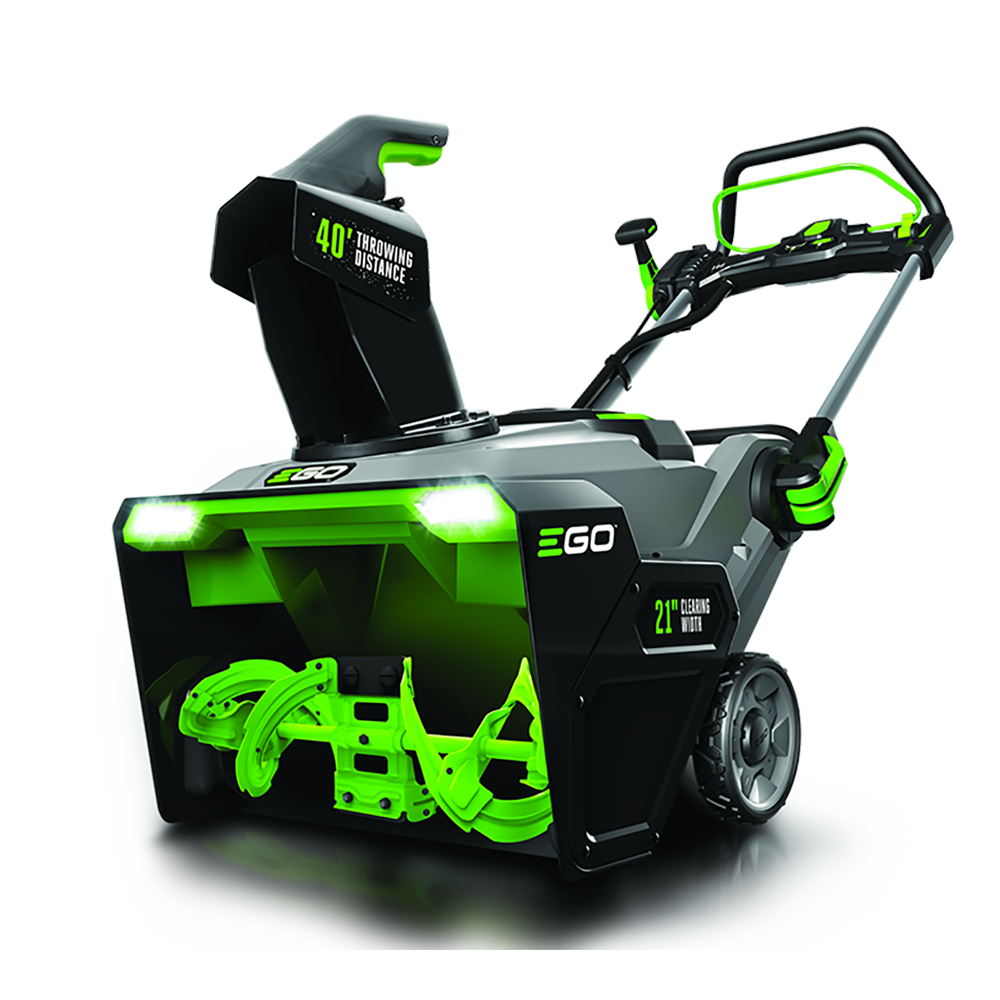
21" wide · 56V 7.5Ah × 2 (Peak Power) · 62 lb
The SNT2114 is the steel-auger trim of EGO's 21-inch single-stage line, and that auger is the whole story — it bites through the crusty end-of-driveway berm that stalls the rubber-paddle SNT2102 and scrapes cleaner down to pavement. Peak Power pulls from both 7.5Ah packs at once, and owners say the gas-equivalent claim mostly holds through 8 inches. Runtime is the honest catch: the hour of light-powder clearing shrinks to 25-35 minutes in heavy wet snow, and the 40-foot throw drops to 15-25 feet once things turn slushy. Cold behavior is manageable if you store the batteries indoors; packs left in a freezing garage give up 10-20% of their capacity until they warm up. Replacement math stings — a BA4200T 7.5Ah runs about $430 — but the $999 kit undercuts a comparable Toro Power Clear gas machine on noise and maintenance while matching it on typical storms. Against Toro's 60V Power Clear 21, the EGO throws harder in wet snow thanks to the dual-battery surge. Skip it only if you routinely get foot-deep dumps — that's two-stage territory.
Best for Homeowners with a 2-4 car driveway and regular 4-10 inch storms who want the single-stage EGO that can actually bite through plow crust.

21" wide · 40V 8.0Ah × 2 · 51 lb
Ryobi's current 21-inch single-stage (the RY40HPSN02K2 replaced the older push-style 21-inch throwers) leans on one clever trick: the auger is angled to pull the machine forward, so the 51-lb unit crawls ahead like a paddle-drive Toro. With two 8Ah packs on dual active ports it claims more power than a 208cc gas engine and 25 car spaces per charge — owners call that generous. The consistent Home Depot review verdict: terrific under 6 inches, strained past that, with batteries draining fast in wet snow and a 35-foot throw that's really 15-20 feet in slush. Longer-term owners also grumble that the plastic auger paddle ends wear down with no cheap replacement part sold. At $799 with two 8Ah batteries it undercuts EGO's steel-auger SNT2114 kit by $200, and the packs share Ryobi's huge 40V yard-tool ecosystem — the single best reason to pick it. Replacement 8Ah batteries run about $279, so baby the included pair and store them indoors; cold-soaked packs sag hard. Versus a Toro Power Clear 721 gas machine you trade deep-storm stamina for silence and zero maintenance.
Best for Ryobi 40V ecosystem owners with short driveways and light-to-moderate snowfall who want self-propelled help at a single-stage price.

24" wide · 40V 6.0Ah × 4 · 187 lb · heated grips
Ryobi's Whisper Series 24 is the RY40870 in its current form — a 187-lb two-stage running four 6Ah packs through dual brushless motors, with heated grips, an LED headlight, and a claim of out-powering a 252cc gas engine. It's genuinely quiet, too; the 35%-quieter-than-gas marketing tracks with owners clearing at 5 a.m. without complaints. Runtime is where owners get blunt: Ryobi says up to 45 minutes, reviewers measure closer to 30 under load, and one owner's 120-by-30-foot driveway in a 12-inch storm about exhausted all four packs. The cable-operated chute deflector feels flimsy next to EGO's electronic control and doesn't always lock position, and a handful of units have shut down when the auger engaged — though Ryobi's warranty service earns praise. At $1,799 street ($1,999 direct) it slots between EGO's $1,649 SNT2405, which lacks its heated grips, and the $2,419 SNT2807. Four replacement 6Ah packs at roughly $200 apiece make the battery-fleet math real. Versus an Ariens Classic 24 gas machine you pay about $700 more for silence and no engine to winterize.
Best for Homeowners in quiet neighborhoods with moderate 6-12 inch storms who want a full two-stage experience with heated grips at mid-tier battery pricing.
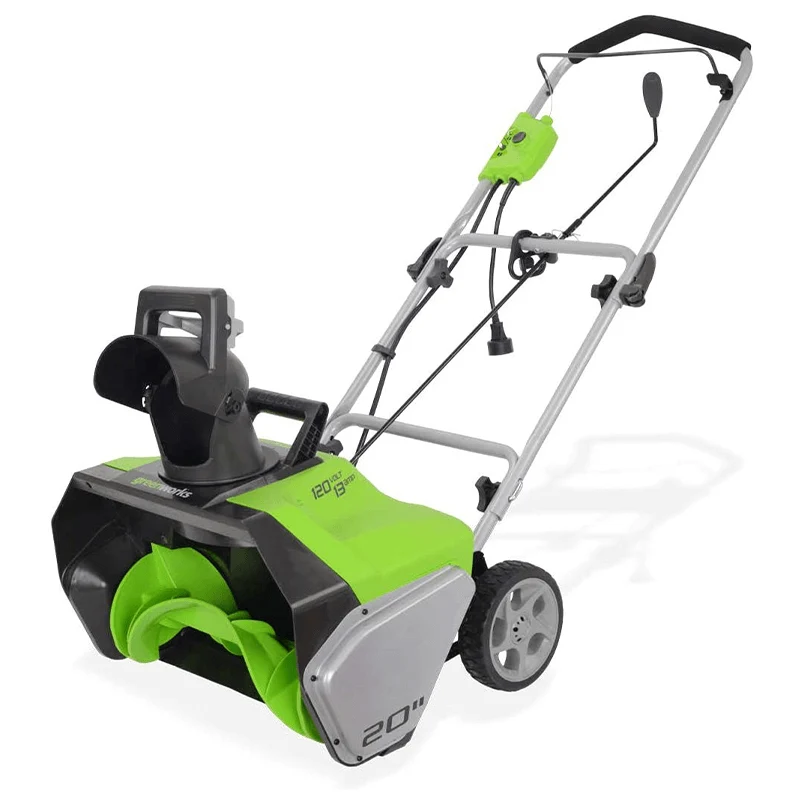
20" wide · 20 ft throw · 32 lb
This is the quiet workhorse of the sub-$150 tier: a 13-amp motor and 20-inch path that four-thousand-plus Amazon reviewers hold at 4.3 stars, which is remarkable staying power for a design that has barely changed in a decade. In up to 6 inches of dry snow it clears down to pavement and throws a respectable 20 feet, and at 32 lbs your grandmother could actually use it — a real consideration in this category. The compromises are classic corded single-stage: wet or plow-packed snow bogs the motor and shortens the throw to a couple of feet, the 10-inch intake means deep storms need two skims, and the extension-cord dance is genuinely annoying on wide driveways. Against the Snow Joe SJ627E you give up 2 inches of width, 2 amps, and the LED lights (unless you find the 2600202 light-kit version) but save $50-80 and gain Greenworks' 4-year warranty — double Snow Joe's. For sidewalks, patios, and short one-car driveways in a moderate climate, it's the value pick that just works.
Best for Budget buyers with sidewalks or a short one-car driveway who want the most reliable sub-$150 electric on the market.
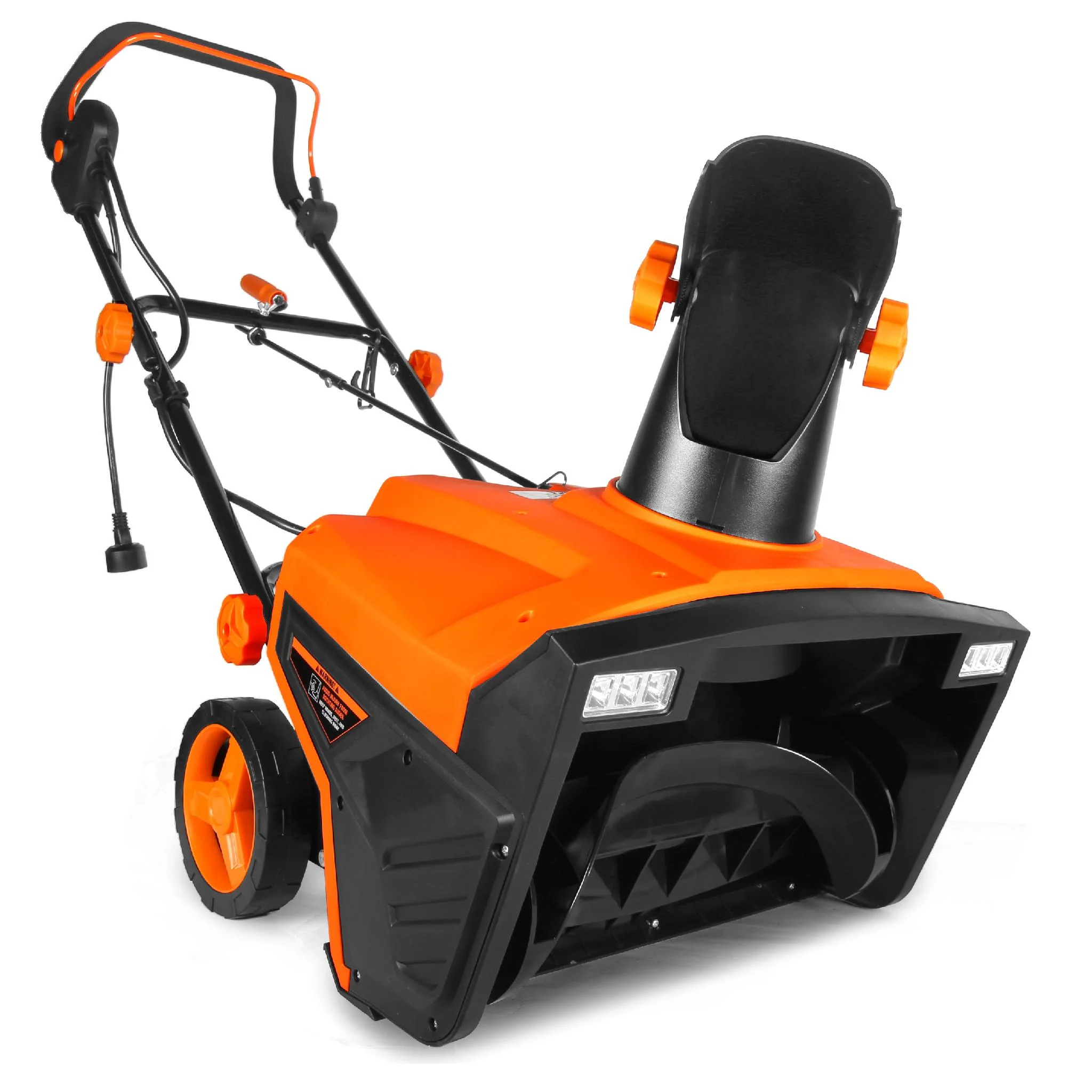
20" wide · 29 ft throw · 36 lb
WEN's follow-up to the long-running 5664 Snow Blaster bumps the spec where it counts — 15 amps instead of 13.5, a 20-inch path instead of 18, a claimed 29-foot throw, and dual LED lights — while keeping the price around $140, which is why Amazon owners call it the best value in electric snow removal and hold it at 4.4 stars. It moves up to 900 lbs of snow per minute in dry powder and the quick-adjust deflector lets you drop the throw low so you're not sandblasting the neighbor's car. The honest limits are the usual corded single-stage ones: wet snow sticks to the chute and clogs it every few feet until you stop and knock it clear (the most common owner complaint), the 10-inch intake wants storms taken in skims, and there's no light-commercial durability here — it's stamped steel and plastic backed by WEN's 2-year warranty. Against the Snow Joe SJ627E it gives up 2 inches of width and some intake depth but costs $60-80 less with a longer claimed throw. For small paved driveways, it's the price-to-power champ.
Best for Value hunters with a small paved driveway or long walkway who want near-SJ627E performance for WEN-tool money.
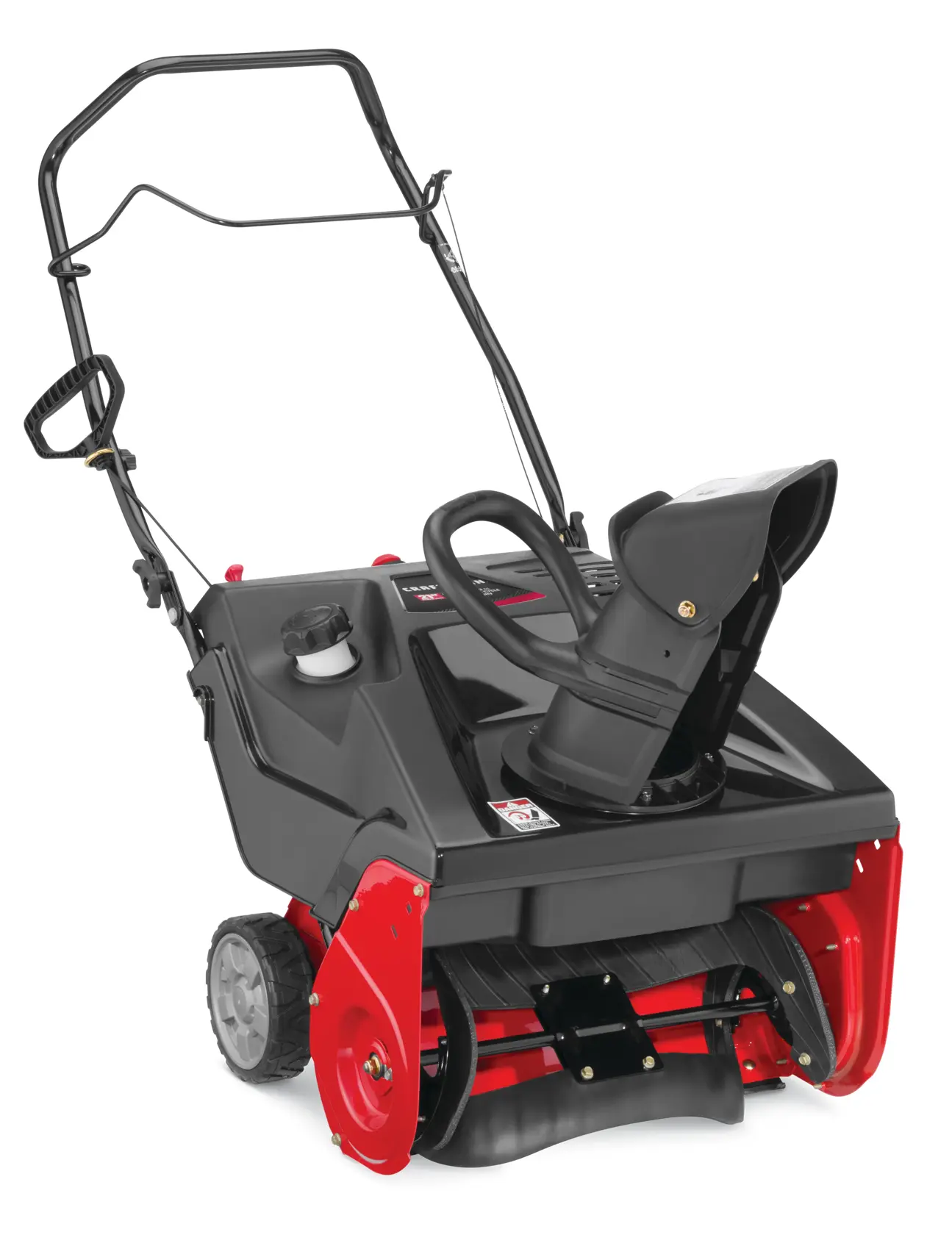
21" wide · 25 ft throw · 95 lb
The SB230 is the budget-gas archetype: a 123cc 4-cycle OHV engine (no oil-gas mixing), push-button electric start so you skip cold-morning pull-cord roulette, and a 21x13-inch mouth that shrugs off the wet, heavy 6-8-inch storms that stall corded and battery single-stages — all for about $549, roughly half what a Toro Power Clear 721 E commands. Built by MTD in Tupelo, Mississippi, it's mechanically simple and the auger-assist pull genuinely lightens the pushing. The honest knocks from Lowe's owner feedback: out-of-box quality control is hit-or-miss (missing hardware, loose parts, and dead electric starters show up in reviews), the ~25-foot real-world throw trails a Toro's, chute parts are polypropylene, and finding warranty service for MTD-built Craftsman gear can be a runaround despite the 3-year coverage. There's no headlight either. If you get a good unit — most people do — it's years of cheap, gas-grade clearing for one-car driveways in serious snow; picky buyers should spend up for the Toro.
Best for Budget-minded buyers in real snow country who need gas-engine grunt for a one- or two-car driveway without paying Toro prices.
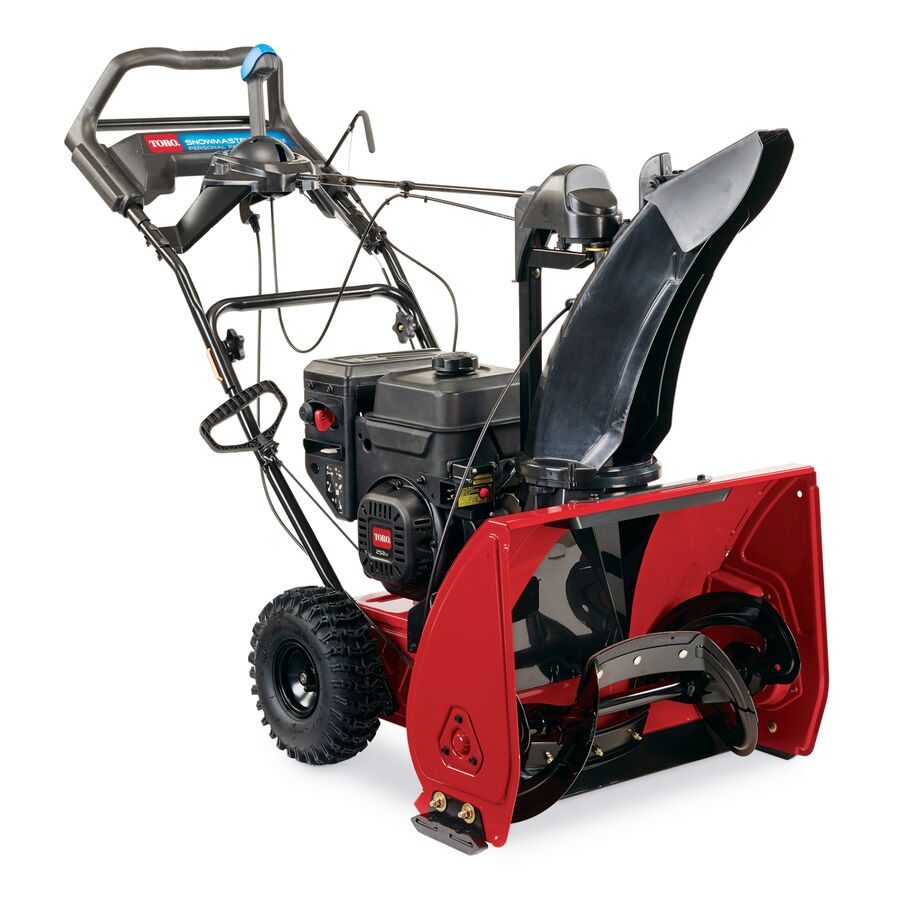
Toro SnowMaster 724 QXE
~$1,19924" wide · 40 ft throw · 125 lb
The SnowMaster is the line Toro built to answer a specific complaint: two-stage machines are slow and heavy, single-stages are too narrow. It takes a 24-inch bite like a two-stage but uses one in-line auger spinning roughly ten times faster than a conventional one, so snow goes straight out the chute instead of being handed to an impeller. The result is a machine that clears a two-car driveway at walking speed and still lifts onto a truck tailgate. The trade-off is honest and worth understanding before you buy: the rubber-edged auger contacts the ground, so this is a paved-surface machine only, and it will not touch a gravel drive. Against the Power Clear 821 QZE it clears three more inches per pass; against the Power Max 824 OE it gives up the ability to handle a packed end-of-driveway berm.
Best for Paved two-car driveways where the storms are frequent but rarely deeper than a foot, and speed matters more than brute force.
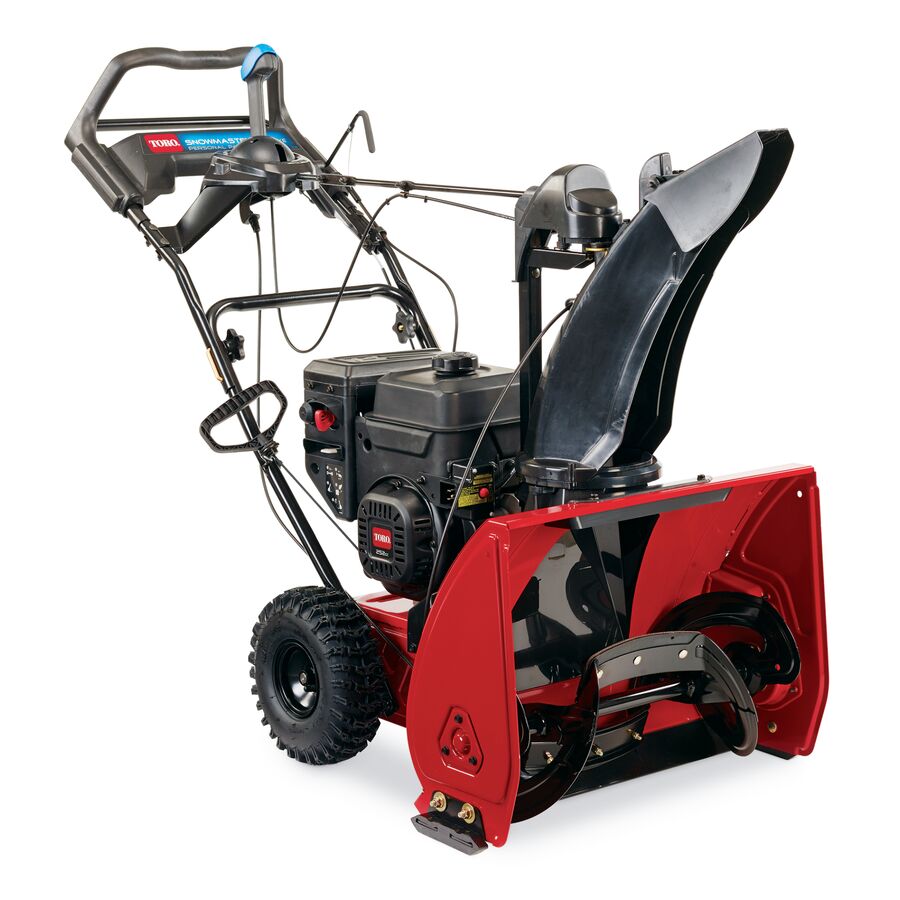
Toro SnowMaster 824 QXE
~$1,24924" wide · 40 ft throw · 131 lb
The 824 QXE is the 724 with a 252cc engine in place of the 212cc and six more pounds on the scale, and that is genuinely the whole difference. Same 24-inch in-line auger, same Personal Pace drive, same 18-inch intake. The larger engine is the answer to the SnowMaster's one real weakness — wet, heavy, late-season snow, where the smaller motor has to be driven slower to keep the auger spinning. For $50 more it is difficult to argue for the 724 unless the machine is going to live somewhere the extra six pounds matters.
Best for The same paved two-car driveway as the 724, in a region where the snow arrives wet and heavy rather than dry and light.
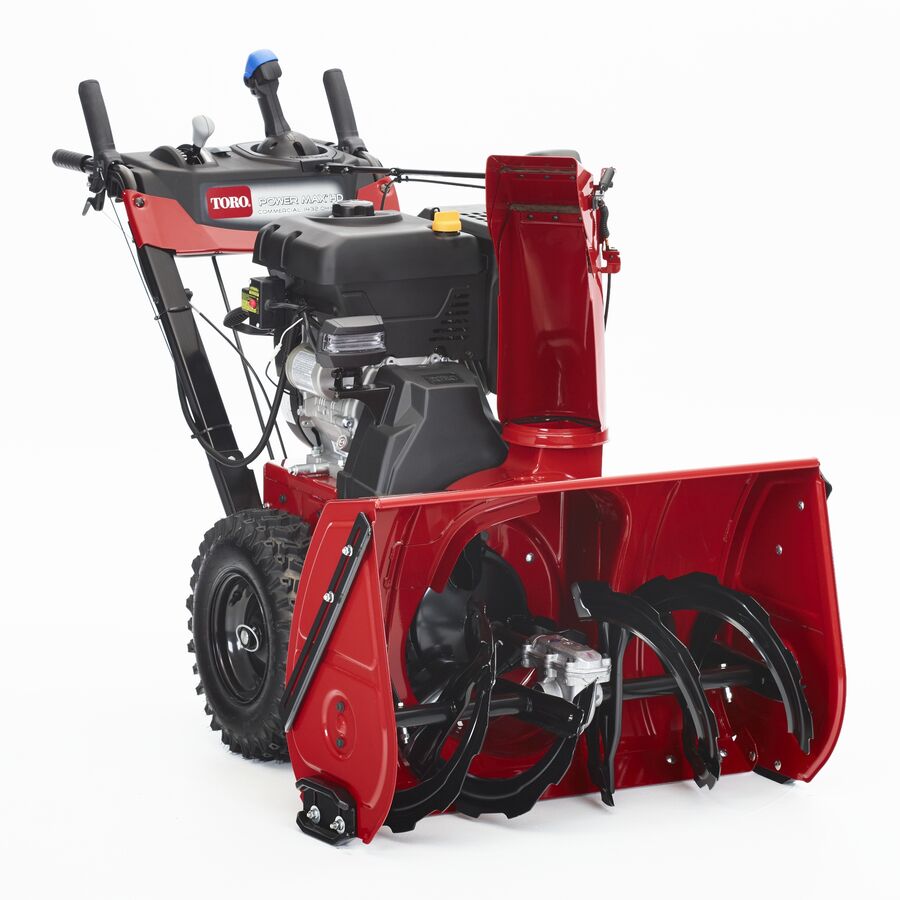
Toro Power Max HD 1428 OHXE
~$2,94928" wide · 65 ft throw · 304 lb
This is the top of Toro's walk-behind line and it is built to a commercial spec — the five-year warranty carries a one-year commercial term, which most residential machines will not do at all. The 420cc engine and 21-inch intake put it in the same conversation as the Ariens Professional 28 RapidTrak, and the 65-foot throw is the longest in this catalog by a clear margin. At 304 lb it is also the heaviest wheeled machine here, which is the honest cost of that capability: it is not a machine you turn around casually at the end of a pass. Worth knowing before you buy — Toro lists heated grips as accessory 131-6460 rather than standard equipment, which contradicts a good deal of dealer copy.
Best for Long or steep driveways in heavy-snow country, and anyone who wants a walk-behind with a warranty that survives light commercial use.
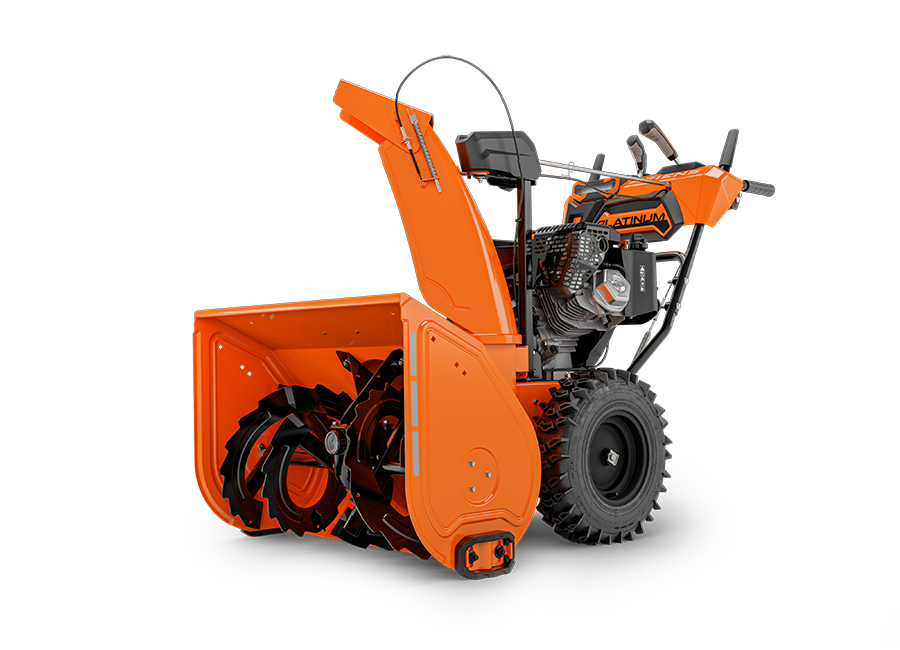
Ariens Platinum 30 SHO
~$2,39930" wide · 55 ft throw · 274 lb · heated grips
The Platinum 30 SHO is what the Deluxe 30 becomes when Ariens stops economising: a 420cc AX engine instead of the Deluxe's 306cc, the Super High Output impeller, handwarmers and a remote deflector as standard, and an in-dash chute lever rather than a crank. Thirty inches of clearing width and a 21-inch intake put it at the top of the residential range without crossing into the Professional line's price. Against the Toro Power Max HD 1428 OHXE it gives up ten feet of throw and the commercial warranty term, but it is thirty pounds lighter, two inches wider, and carries heated grips as standard rather than as an accessory.
Best for Wide or long driveways in serious snow country where a 24-inch machine means too many passes and heated grips are not negotiable.
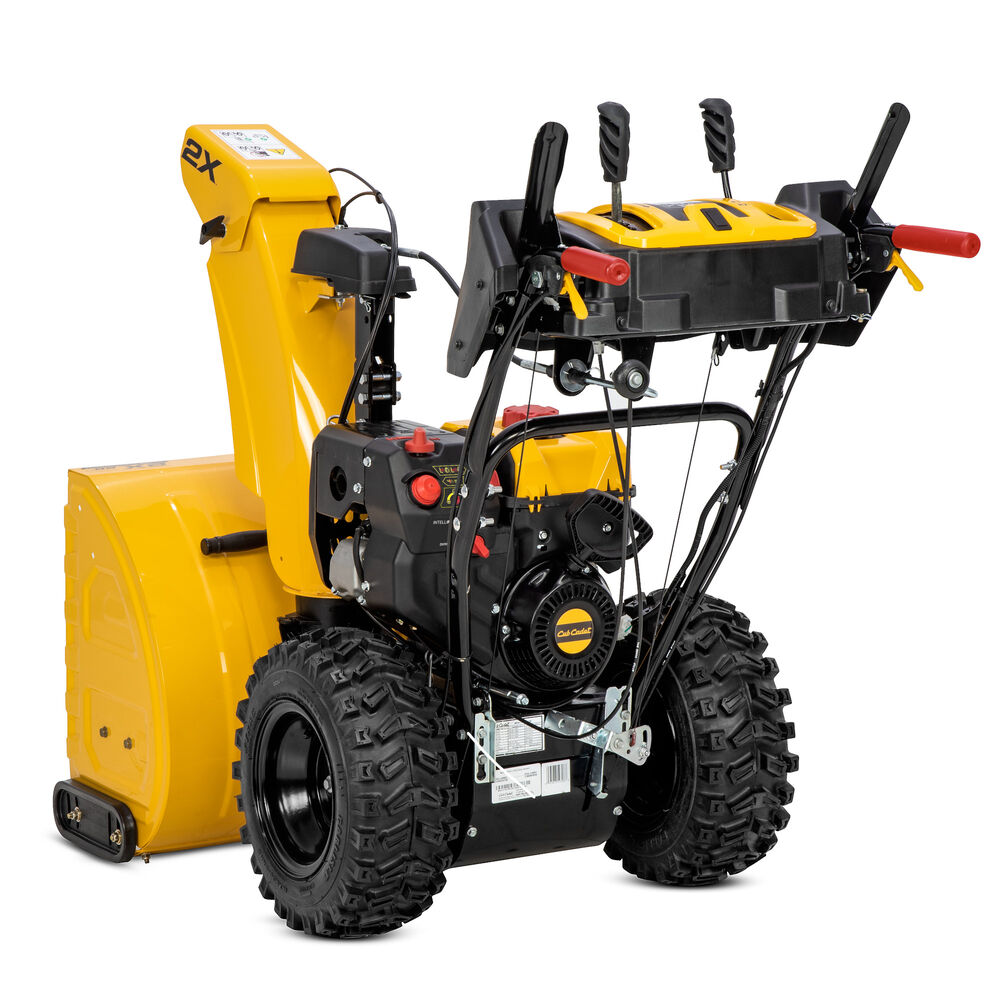
Cub Cadet 2X 28 IntelliPOWER
~$1,67928" wide · 40 ft throw · heated grips
The 2X 28 sits between the 2X 26 and the three-stage 3X line, and the reason to want it is all-wheel drive — both wheels pull, which is the difference between climbing a sloped or unpaved driveway and spinning one tire on it. IntelliPOWER is Cub Cadet's name for an engine tuned to hold output as load rises rather than bogging, which is the usual complaint about mid-size two-stage machines in wet snow. Heated grips, dual LED headlights and trigger power steering are all standard at this price. Cub Cadet does not publish a weight for this machine on its own product page, at Tractor Supply, or at Home Depot, so it is left blank here rather than guessed.
Best for Sloped, long, or unpaved driveways where a single-wheel-drive machine loses traction, in up to a foot of snow at a time.
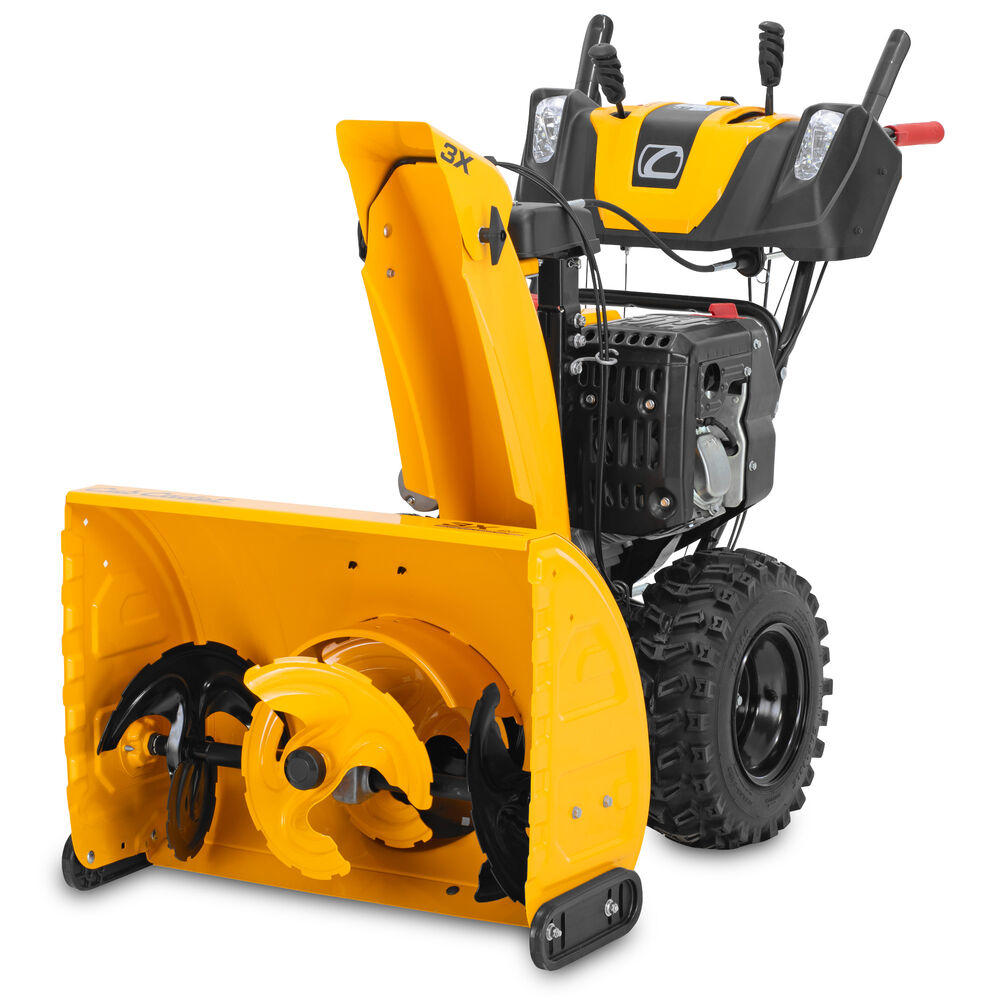
Cub Cadet 3X 28 IntelliPOWER
~$1,89928" wide · 279 lb · heated grips
Three-stage machines exist for one job: the compacted ridge a plow leaves at the end of a driveway. The accelerator between the augers and the impeller chews that ridge apart instead of stalling on it, and the 23-inch intake — two inches taller than the 2X 28 — is what lets the machine get its mouth around it in the first place. Cub Cadet rates the 3X line to about 23 inches of snowfall against the 2X's 12. The price of all that is 279 lb and a more complex drivetrain with one more wear point than a conventional two-stage.
Best for Driveways that get plowed in, where the real problem is a hardened end-of-drive berm rather than the snowfall itself.
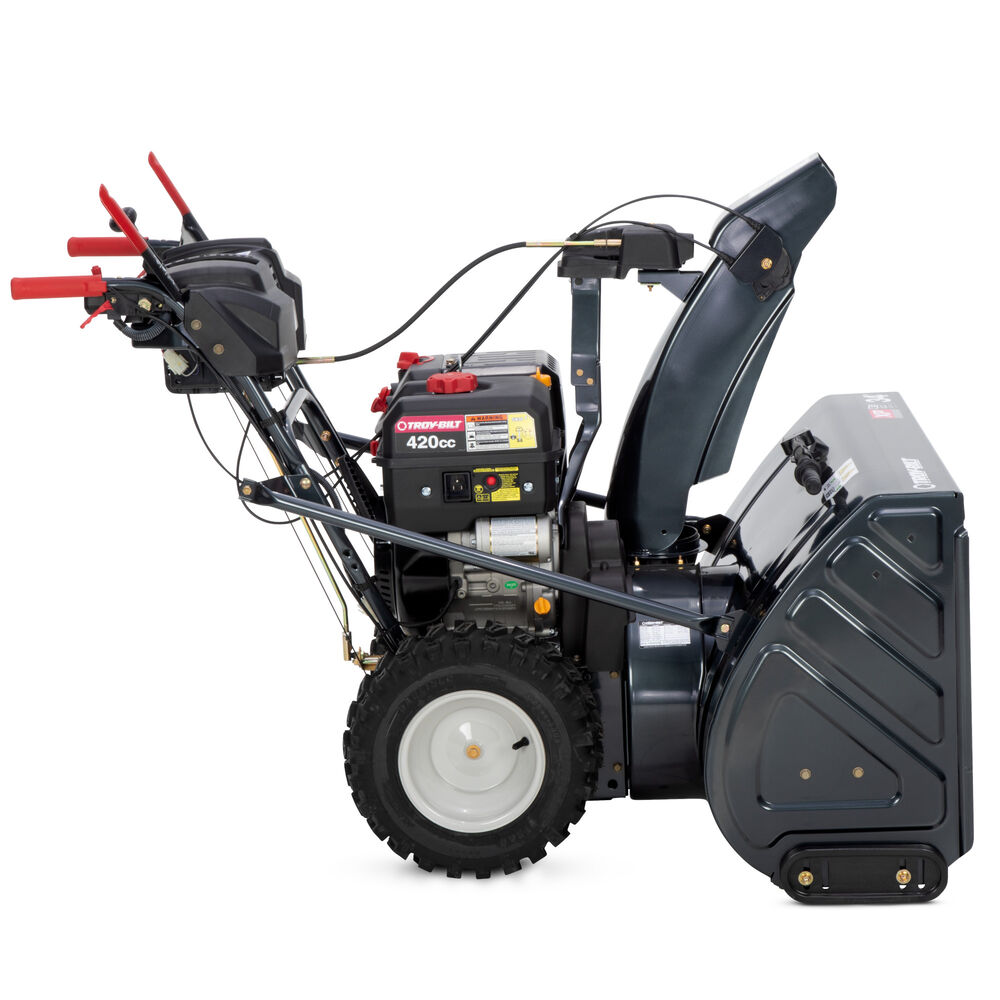
34" wide · heated grips
Thirty-four inches is the widest machine in this catalog, and the Arctic Storm's pitch is straightforward: the same 420cc engine as Toro's $2,949 flagship, six more inches of clearing width, and a $1,250 lower price. What you give up for that is a three-year residential warranty instead of five, a brand with a thinner dealer network than Toro or Ariens, and a machine whose sheer width is a genuine storage problem. The electric four-way chute control is unusual at any price — most machines in this range still use a crank for rotation and a lever for pitch.
Best for Long, wide rural driveways where the number of passes is the thing that actually costs you time.
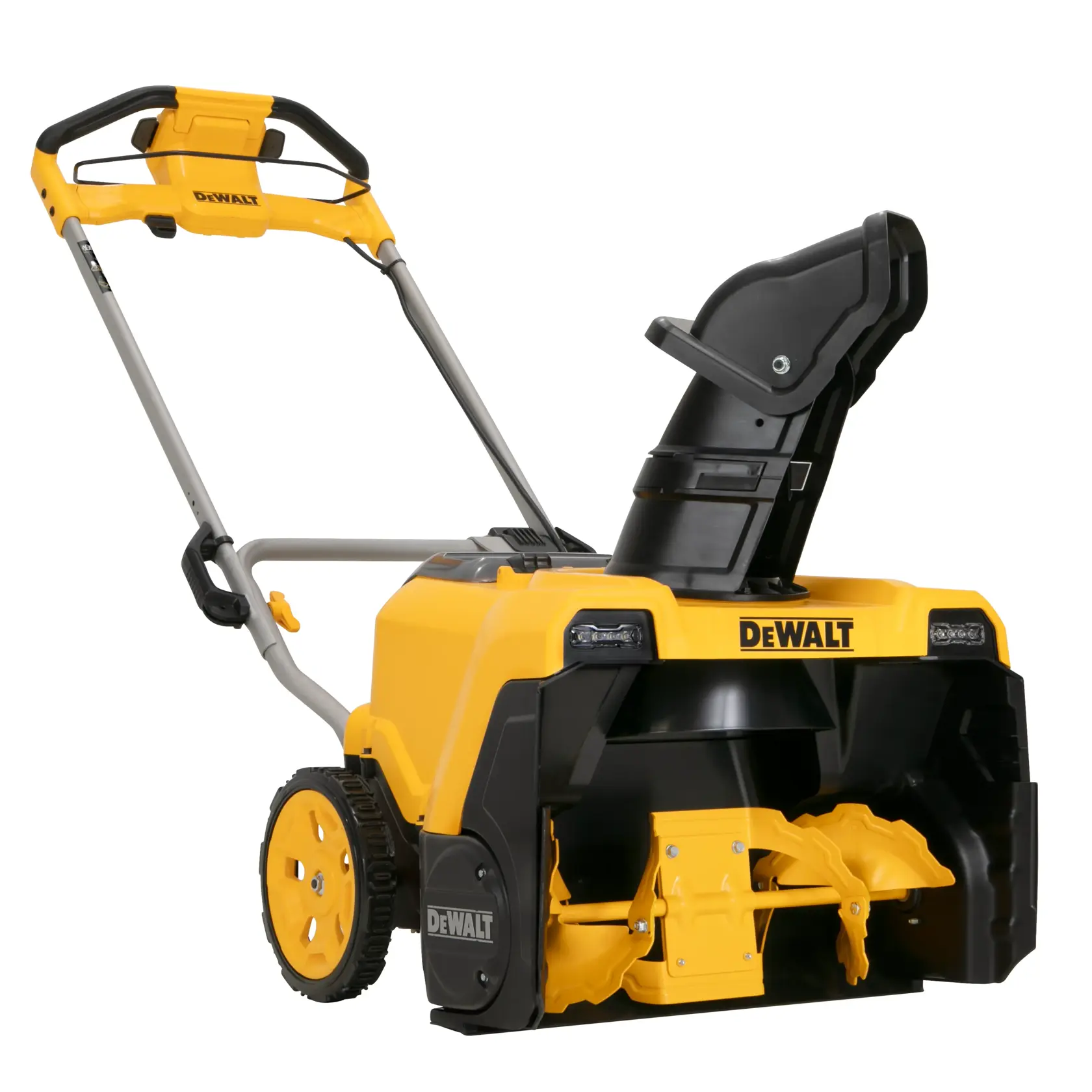
21" wide · 60V MAX FlexVolt brushless · 88 lb
DeWalt's case for this machine is not really about snow. It is that a contractor or homeowner already holding a shelf of 60V FlexVolt batteries can add a snow blower without adding a second battery platform, a fuel can, or a spring carburetor cleaning. The machine itself is a conventional 21-inch single-stage: 88 lb, a 40-foot throw, and the paved-surface-only limitation every auger-propelled machine carries. It competes directly with the EGO SNT2102 and the Ryobi 40V single-stage, and the deciding factor between them is almost always which batteries are already in the garage.
Best for Anyone already invested in DeWalt's 60V FlexVolt platform who wants a paved driveway cleared without keeping a gas machine running.
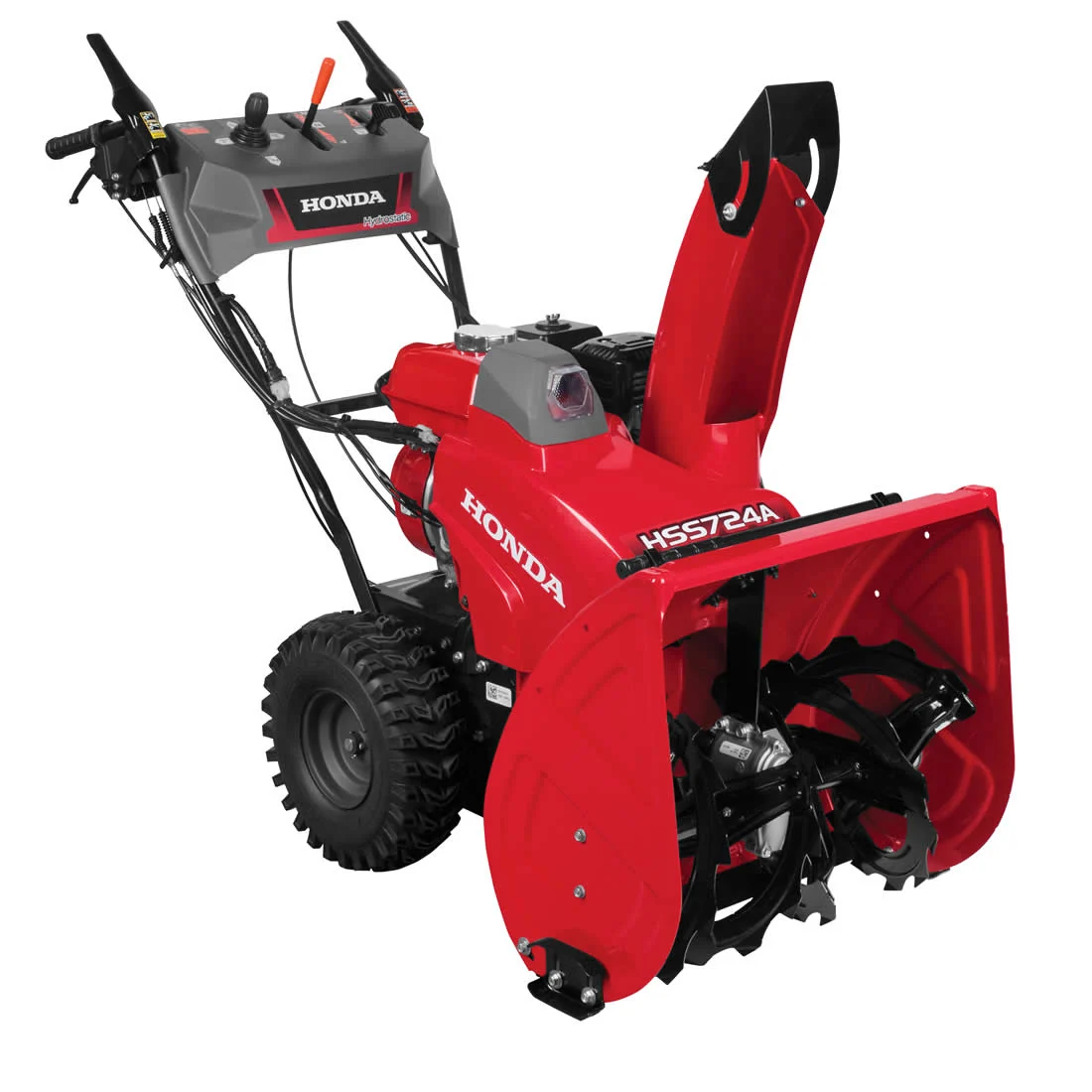
Honda HSS724AWD
~$2,94923.8" wide · 49 ft throw · 220 lb
This is the wheeled sibling of the HSS724ATD already in this catalog, and the choice between them is the whole story. Tracks give you grip on ice and slopes and the ability to tilt the bucket; wheels give you a machine that turns without fighting you and costs less. Both run the same commercial GX200 engine and the same hydrostatic drive, which is the reason people buy Hondas in the first place — the speed lever is continuous rather than stepped, so in deep snow you can creep at whatever pace the auger will actually take. It is also the only Honda in this catalog with an Amazon listing, which matters only because every other Honda here is dealer-order.
Best for Flat-to-moderate paved or gravel driveways where Honda's engine and hydrostatic drive are the draw, and the ice-grip of tracks isn't needed.
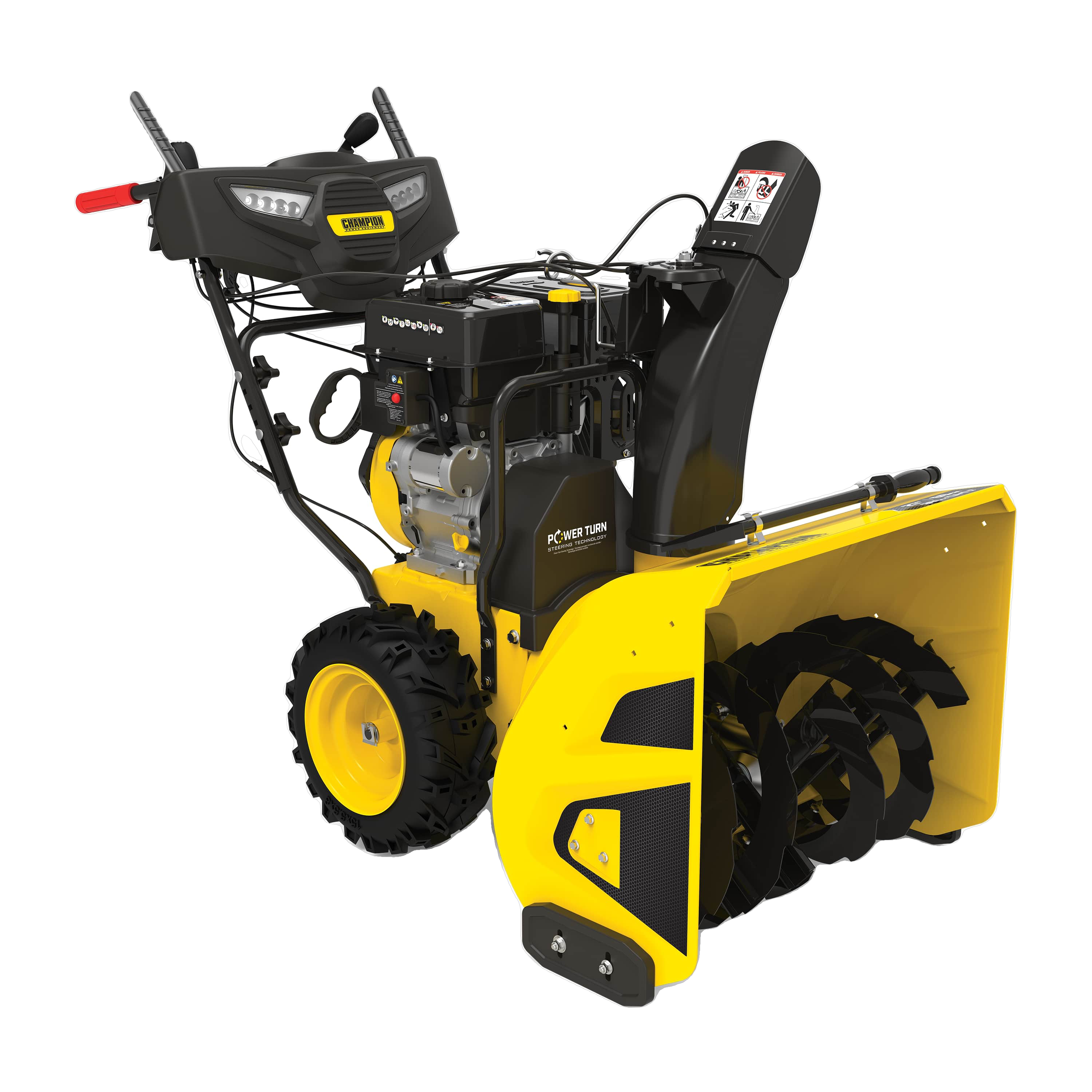
27" wide · 40 ft throw · 234 lb · heated grips
Champion is better known for generators, and the snow line is priced accordingly: a 301cc engine, a 23-inch intake and heated grips for a little over $1,100, where Ariens and Toro want $1,700 and up for the same numbers. The catch is the one that applies to the whole value tier — a two-year warranty against three or five, and a service network built around big-box returns rather than dealers who stock parts. The 23-inch intake is the specification worth noticing here; it is taller than the Cub Cadet 2X 28's and matches the three-stage machines, which is unusual at this price.
Best for A wide driveway on a budget, where the intake height and engine size matter more than dealer support.
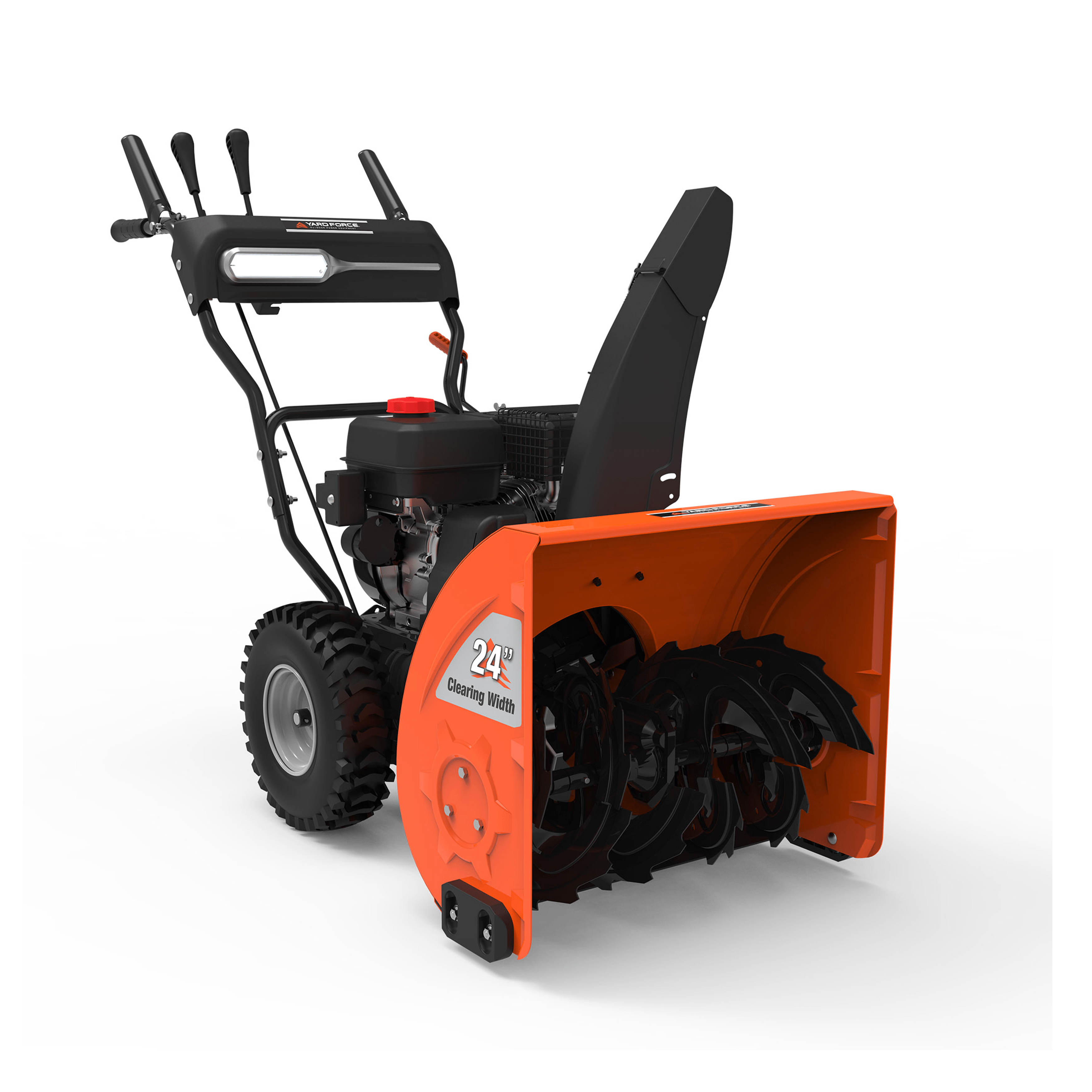
24" wide · 40 ft throw · 163 lb
The pitch here is a Briggs & Stratton engine at a price where the value tier usually fits an unbranded clone. At 163 lb it is one of the lighter 24-inch two-stage machines in this catalog — about 25 lb under the Ariens Compact 24 — which makes it easier to turn and store, and correspondingly less planted in heavy snow.
Best for A standard two-car driveway where a recognised engine brand matters but a dealer network doesn't.
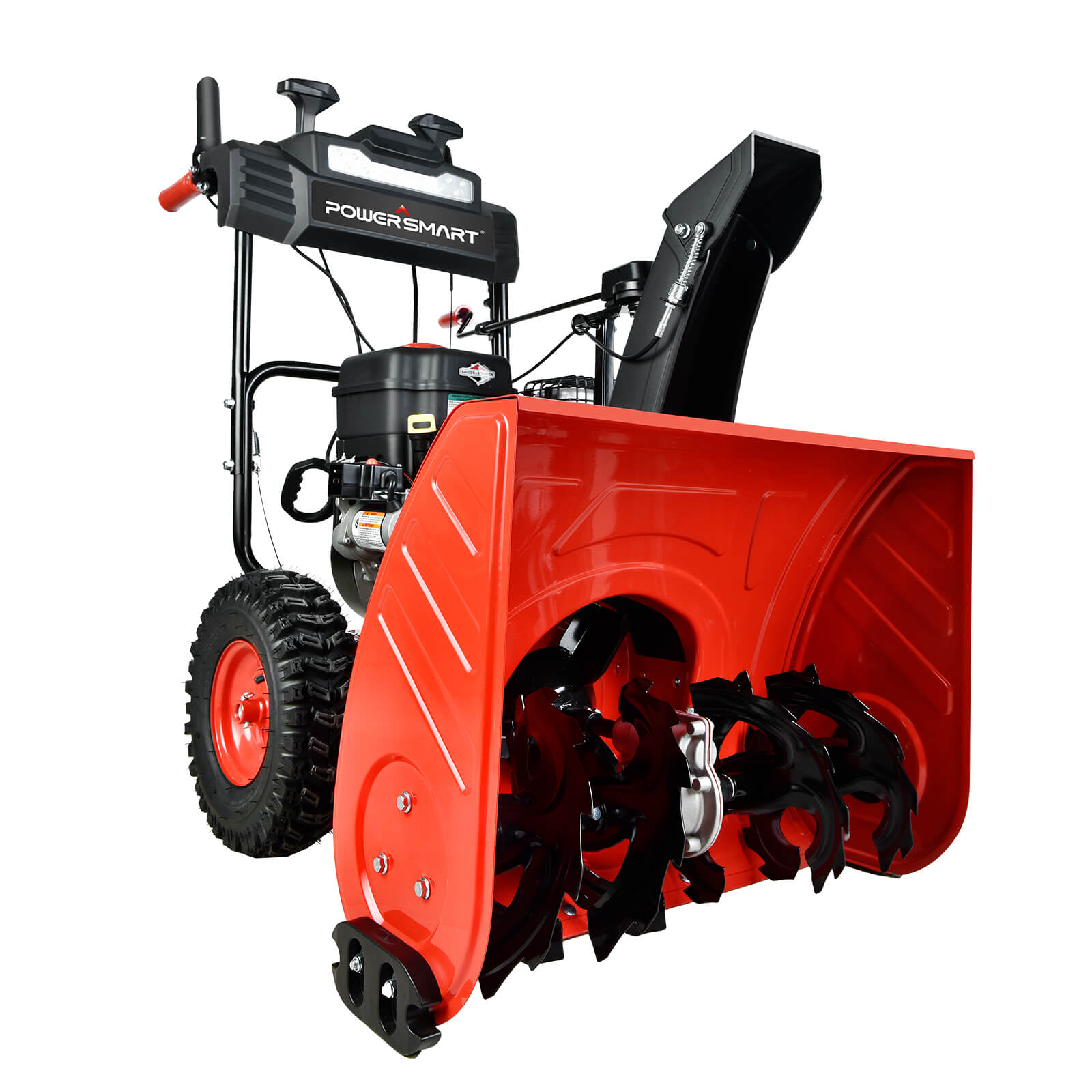
26" wide · 45 ft throw · 145 lb · heated grips
PowerSmart's 26-inch is the widest machine in this catalog under $1,000, and it pairs that with a Briggs & Stratton engine and handle warmers. The compromises show up in the details rather than the headline: 180 degrees of chute rotation where most machines give 200 or more, a 20-inch intake that is an inch or two short of its size class, and a two-year warranty. At 145 lb it is remarkably light for 26 inches of width, which helps in the garage and hurts in wet snow.
Best for A wide driveway on a tight budget, in regions where the snow is frequent but rarely wet and heavy.
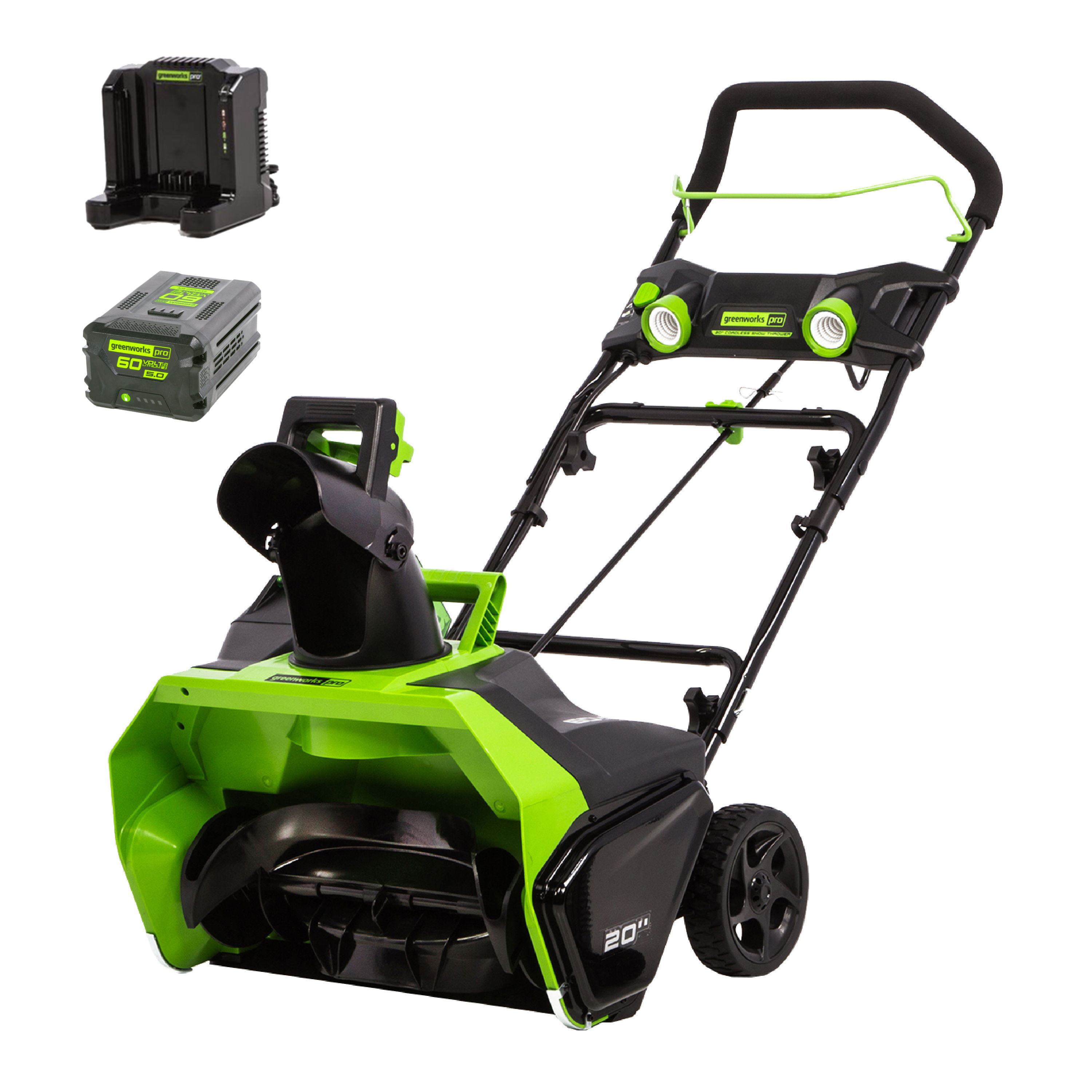
20" wide · 60V brushless · 34 lb
Greenworks runs two battery platforms and this is the 60V one, sitting below the 80V machines already in this catalog. Ten inches of intake and 34 lb put it firmly in sidewalk-and-deck territory rather than driveway duty — it is closer to a powered shovel than to the 80V 24-inch two-stage. Worth buying only if the 60V batteries are already in the garage; if you are starting fresh, the 80V line is the better platform to enter.
Best for Decks, sidewalks, steps and short paved paths, for someone already on the Greenworks 60V platform.
Before you buy your first one
The questions every thread starts with
12 questions that come up in every owner-forum thread, answered without the marketing layer.
Do I need a single-stage or two-stage snow blower?
Single-stage machines — one rubber-edged auger that scoops and throws in one motion — handle up to about 8 inches of snow on paved, mostly flat driveways, and their auger touching the pavement means they scrape cleaner than anything else. Two-stage machines add an impeller behind a steel auger, ride on skid shoes, and are the answer for anything deeper than 8 inches, anything wet and heavy, any gravel surface, and the compacted wall the city plow leaves at the end of your driveway. That plow pile is the real test: single-stagers bounce off it, two-stagers eat it. The full decision guide →
Are battery snow blowers actually good enough yet?
For single-stage duty, genuinely yes — EGO's and Toro's 21-inch battery units clear a two-car paved driveway of 6-8 inches on a charge, start instantly at 0°F, and skip the whole carburetor-and-stale-gas ritual. The honest limits: runtime claims assume fluffy snow, and deep wet stuff can halve them; batteries need to live indoors; and replacement packs run $300-$600. Battery two-stage machines exist and work, but on a long driveway in lake-effect country, gas is still the safer bet. Battery vs gas, honestly →
What size snow blower do I need?
Width determines passes, not capability: a 24-inch machine does a two-car driveway fine, just in a couple more laps than a 28. What actually matters is matching the class to your snow and surface — intake height taller than your big storms, enough engine for the width (the community rule of thumb is roughly 10cc per inch of width; underpowered wide machines are the classic budget trap), and a machine you can physically wrangle. Buy for your ten worst days a year, then make sure it fits through the shed door. Full sizing guide →
How much do I actually need to spend?
Corded electrics run $100-$200 and cover sidewalks and short city driveways. Decent single-stage gas or battery is $400-$800. The quality two-stage tier — where Ariens Deluxe and Toro Power Max live — is $1,100-$1,800, and that jump from a $700 big-box machine buys a cast-iron gearbox, real steering, dealer support, and a 10-to-20-year lifespan instead of five. Above $3,000 you're into hydrostatic track machines like Honda's, which are magnificent and unnecessary for most driveways. Full cost breakdown →
Why won't my snow blower start, and how do I avoid it?
It's almost always fuel: ethanol gas left in the carburetor over summer turns to varnish and gums the jets — this single mistake fills small-engine shops every November. The fix costs nothing: run the carb dry or treat every tank with stabilizer, and consider paying extra for ethanol-free fuel in the fall. The rest of the annual ritual is 30 minutes: fresh oil, check the belts and shear pins, grease the auger shaft, and pull the cord once in October instead of discovering the problem in the first storm. The 30-minute checklist →
Can I use a snow blower on a gravel driveway?
Only a two-stage (or three-stage) machine, and only set up right. A single-stage's rubber auger touches the ground — on gravel it becomes a rock-throwing machine that eats its own paddles. Two-stage machines ride on adjustable skid shoes: raise them so the auger housing floats about three-quarters of an inch over the surface and the machine passes over the stones instead of collecting them. Track-drive machines are even better on gravel and slopes, which is why rural buyers gravitate to them.
When is the best time to buy a snow blower?
The two windows are March-April, when dealers clear floor stock at real discounts, and September-October, when selection is best and pre-season sales run 10-15% off. The worst time is the day after the first big storm, when everything within 100 miles is sold out and sells at sticker. If you're buying premium (Ariens, Honda-class, Toro's bigger machines), a local dealer in the off-season will often beat big-box pricing and actually service what they sell.
Can a battery snow blower handle the plow pile at the end of the driveway?
The EOD pile is the honest dividing line. The current 56-80V two-stage battery machines handle a same-day plow berm; what humbles them is the refrozen overnight pile — dense ice chunks drain batteries fast and demand the nibble technique (attack from the top, half-bites). Owners in plow country report the battery two-stages genuinely work but eat a second battery doing it, while battery single-stages should stay away from EOD ice entirely. If your plow pile refreezes before you get to it regularly, gas two-stage is still the no-asterisk answer. Battery vs gas, honestly →
My snow blower is clogged — how do I clear it without losing fingers?
Never with your hand — not with the engine off, not for a second. A stalled impeller stores belt tension like a mousetrap, and pulling the clog releases it: the auger snaps forward with hundreds of pounds of force, which is how thousands of experienced owners lose fingers every winter. Engine off, wait for all motion to stop, then break the clog with the clearing tool clipped to the handlebar (or any stick), top down. Thirty seconds, every time, no exceptions. The safety chapter →
What are shear pins and why do they keep breaking?
Mechanical fuses: soft bolts designed to snap when the auger bites something immovable, so a $2 pin dies instead of a $300 gearbox. One auger side spinning free means a pin let go — a five-minute driveway fix if you keep correct spares zip-tied to the handlebar. Two rules: never substitute a regular bolt (it transfers the impact straight into the gearbox), and if pins break constantly, fix the cause — skid shoes too low on gravel, a bent auger, or ramming the ice pile instead of nibbling it. Shear pins, explained →
What should I check before buying a used snow blower?
Insist on a cold start (a pre-warmed machine hides the carb problems you're buying), then fifteen minutes of hands-on: rock the augers for bearing play, spin the impeller for housing contact, rock it in gear to test the friction-disc drive, and wiggle the auger shafts for gearbox grind — the one repair that totals old machines. Pricing sanity: a healthy 5-10 year old Ariens or Toro two-stage at 40-60% of new is the best value in the category; 'ran last year' with no demo today is a parts machine. The full used checklist →
Is an Ariens or Toro really worth it over the cheaper brands?
The $600-$800 MTD-built machines (Craftsman, Troy-Bilt, budget Cub Cadet) clear snow fine when new — the difference shows up in year five. The premium brands buy you a cast-iron auger gearbox instead of aluminum, better steel, trigger or auto-turn steering that transforms end-of-driveway turns, a dealer network that stocks parts, and resale value. The standing advice in owner forums is that a 10-year-old used Ariens beats a new budget machine at the same price — that tells you most of what you need to know.